Catch-All Emails: Validation Challenges Explained
Treating catch-all domains as valid destroys deliverability; signal-based verification and careful segmentation are essential for reliable B2B outreach.

Catch-all emails - those that accept all messages sent to a domain, regardless of address validity - pose serious challenges for email marketers and sales teams. They make up 40–60% of B2B email lists, and their tricky nature can lead to higher bounce rates and damage to your sender reputation. Here’s the problem: basic email verification tools can’t reliably determine if these addresses are valid, as catch-all servers always respond positively to emails.
Key takeaways:
- Unverified catch-all emails are 27x more likely to bounce.
- Sending to these addresses can raise bounce rates above 9%, far exceeding the 2% threshold email providers tolerate.
- However, verified catch-all contacts often yield a 67% higher engagement rate, as they’re frequently used by decision-makers.
To address this, email validation tools like ZeroBounce, NeverBounce, Enrichfox.ai, Allegrow, and ExactVerify use various methods to tackle catch-all challenges. These include multi-layered verification, AI scoring, and real-time APIs. Each tool has unique strengths, from Allegrow’s signal-based system to Enrichfox.ai’s cost-efficient pay-as-you-go model. But no single solution is perfect - accuracy, cost, and speed vary widely.
This article compares their approaches, accuracy rates, and pricing to help you choose the best tool for managing your B2B email lists.
1. ZeroBounce
Catch-All Detection Accuracy
ZeroBounce employs a two-phase validation process. The first phase consists of standard SMTP checks, while the second, called Verify+, involves sending test emails over a 48-hour period. The platform also provides an AI-driven Quality Score, which rates email addresses on a 0–10 scale. This score is meant to estimate the likelihood of an address being active, but critics argue it measures probability rather than certainty.
In a February 2026 benchmark involving 1,222 emails from well-known catch-all domains like Nvidia and Sage, the Standard process identified 70% of real email addresses with an 8.1% false positive rate. When the AI Scoring feature was enabled, detection improved to 74%, with a slight increase in the false positive rate to 8.2%. However, the Verify+ feature significantly boosted detection to 96% of real contacts, though it came with a major drawback - a 33.1% false positive rate. This means roughly one-third of invalid addresses, such as "morpheus.matrix@hcltech.com" and "han.solo@dukehealth.org", were incorrectly validated as real.
These results highlight the challenges posed by corporate email filters.
"The fundamental flaw in email-send verification is the assumption that 'no bounce = valid address.' This isn't true... corporate gateways silently quarantine test emails instead of bouncing them." - Allegrow
Enterprise systems often suppress bounce notifications, which can lead to false validations.
Error Handling
To address validation challenges, ZeroBounce uses a multi-layered approach. If Phase 1 detects at least 10 catch-all emails, the system automatically triggers Phase 2 for deeper analysis. This process aims to reclassify addresses as either "Valid" or "Invalid". Additionally, the AI scoring system helps users separate high-activity leads from dormant or high-risk contacts. However, the documentation acknowledges the inherent difficulty of validating catch-all domains, which often employ complex filtering systems that can impact accuracy. Users who prefer faster results can choose to disable Phase 2 validation during file upload, avoiding the 48-hour wait time.
Cost considerations also play a role in how users approach validation.
Pricing
ZeroBounce operates on a credit-based pricing model, charging $0.01 per credit. Standard validation uses one credit per email, while enabling the AI Scoring feature requires an additional credit for each catch-all address. This can significantly increase costs for lists with a high percentage of catch-all domains. The Verify+ feature, while not requiring extra credits, does demand an opt-in and takes up to 48 hours to process. Additionally, users with business or premium domains receive 100 free credits each month.
In the February 2026 benchmark, validating 1,222 emails in Standard mode cost around $12.22 and took roughly 4 minutes. When AI Scoring was added, the cost rose to $17.71.
These pricing dynamics underscore the trade-offs between speed, accuracy, and cost when managing catch-all email lists.
2. NeverBounce
Catch-All Detection Accuracy
NeverBounce uses standard SMTP handshakes to validate email addresses, which works well for most standard email setups but struggles when it comes to catch-all domains. Catch-all servers always return a 250 SMTP response, regardless of whether the mailbox actually exists, making it impossible for NeverBounce to confirm the validity of these addresses. This is a big deal because about 42% of B2B email lists include catch-all domains, leaving a significant number of email addresses categorized as "unknown".
While NeverBounce performs reliably on straightforward validations, it falls behind specialized tools that use advanced techniques - like burner accounts or behavioral data - to verify 70-80% of catch-all addresses. This gap highlights the need for a cautious and thoughtful approach, which is reflected in the tool's error-handling methods.
Error Handling
To address its limitations with catch-all domains, NeverBounce takes a conservative approach to classification. It flags uncertain catch-all emails as "unknown" or "risky" to protect your sender reputation. This way, users are discouraged from assuming that a 250 SMTP response guarantees a valid email address. However, this cautious stance presents a challenge because these "unknown" emails often belong to large organizations - potentially high-value prospects.
Sending to unverified catch-all addresses can drive bounce rates above 9%, far exceeding the 2% limit that most Email Service Providers tolerate. To avoid this, users should segment out "unknown" addresses and apply additional validation methods, such as AI-based scoring or small-batch testing, before sending emails. This extra step can help maintain deliverability while avoiding penalties from email providers.
3. Enrichfox.ai
Catch-All Detection Accuracy
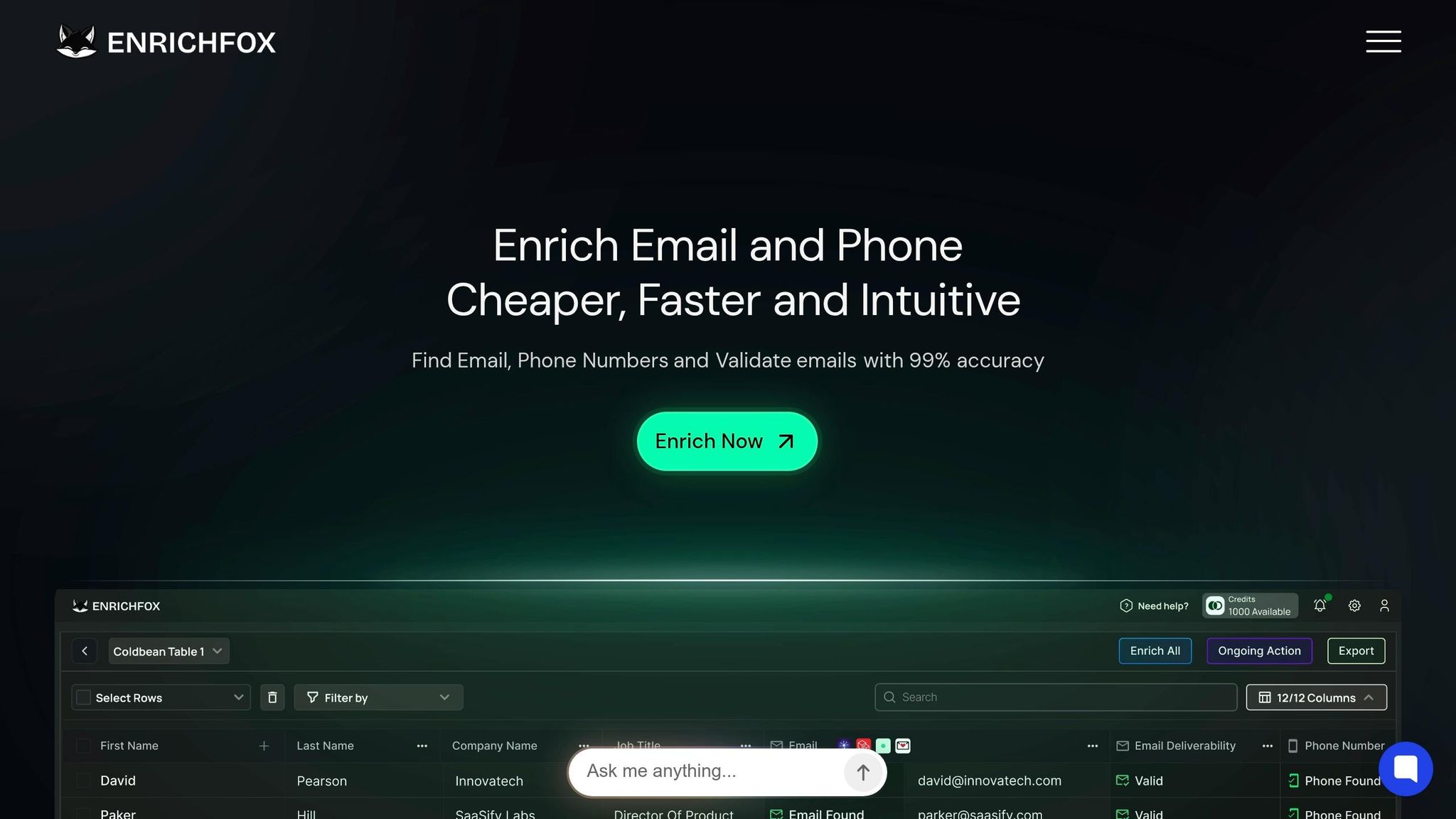
Enrichfox.ai takes a fresh approach to email validation with its "Waterfall advantage" method. This technique is specifically designed to identify valid emails within catch-all domains - those that other platforms often label as "unknown". By addressing this common issue, Enrichfox.ai helps recover 20–30% more usable contacts from risky "accept-all" lists compared to traditional tools.
The platform doesn’t stop there. It provides a confidence score (e.g., "confidenceScore: 99") and even identifies the specific SMTP provider, such as Google or Office 365, for each email address. This extra layer of detail empowers users to make smarter decisions about whether to engage with catch-all emails.
Contact-Level Validation
To further boost accuracy, Enrichfox.ai employs a triple-verification layer combined with a custom provider score. This multi-step process is designed to catch "bad" emails that single-layer tools might miss. By detecting error signals - not just activity - it flags invalid addresses on catch-all domains right away. This proactive approach saves credits and safeguards your sender reputation by ensuring you’re not wasting resources on undeliverable emails.
Pricing
Enrichfox.ai uses a pay-as-you-go model, charging only for successful validations:
- Valid verified email: $0.00025
- Valid email found (but not fully verified): $0.05
- Valid phone number for enrichment: $0.03
This pricing structure ensures you’re only paying for results, making it both cost-effective and transparent.
4. Allegrow
Catch-All Detection Accuracy
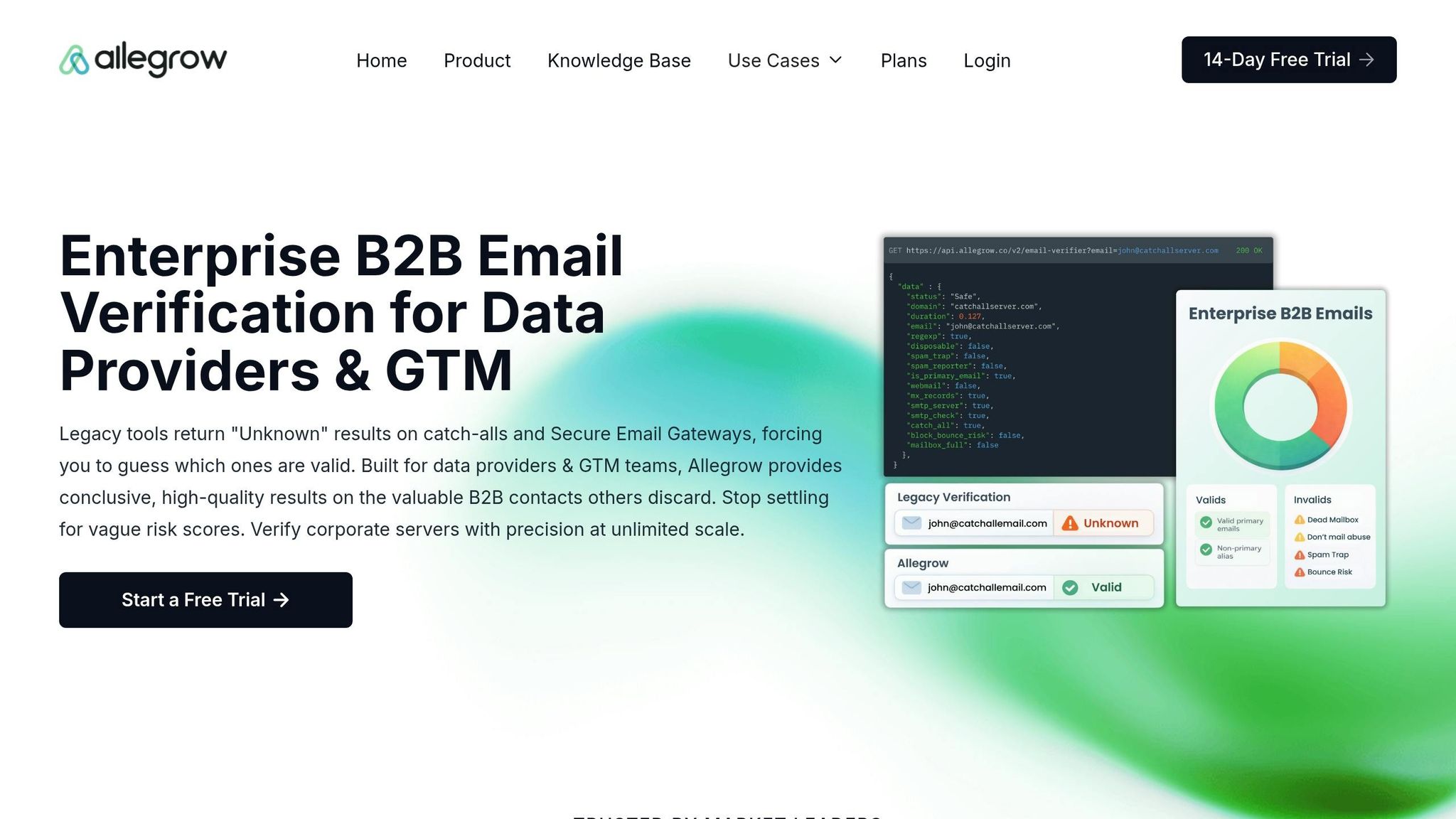
When it comes to tackling the tricky issue of validating catch-all email addresses, Allegrow takes a different route. Instead of relying on basic SMTP checks or sending test emails, it uses over 30 proprietary risk signals. This approach allows the platform to deliver clear verdicts - either "Safe" or "Unsafe" - for email addresses on catch-all domains. In a 2025 benchmark study involving 1,222 emails, Allegrow achieved a perfect score, identifying 100% of real contacts while keeping the false positive rate to an impressively low 0.1%. For comparison, ZeroBounce Standard detected only 70% with an 8.1% false positive rate, and Verify+ had a 33.1% false positive rate. Allegrow’s precision doesn’t stop there - it also fine-tunes validation at the individual contact level.
Contact-Level Validation
Allegrow goes beyond just identifying valid emails. It digs deeper by analyzing individual account activity to filter out inactive or "zombie" accounts - mailboxes that technically exist but show no signs of human use. To add another layer of protection, Allegrow includes a "Safety Net" feature. This integrates with sales engagement tools like Outreach and Salesloft, automatically blocking risky emails before they even enter your workflows.
Error Handling
To minimize the risks associated with catch-all domains, Allegrow uses a detailed error categorization system. It tags catch-all addresses with labels like "dead_email" (indicating an invalid address that won’t bounce due to the catch-all setup), "block_bounce_risk", and "spamtrap". Additionally, the platform performs hourly checks for SPF, DKIM, and DMARC authentication to flag any configuration issues that might hurt email deliverability.
The results speak for themselves. In 2025, Lindsay Minnema, Sales Enablement Specialist at Booster, shared that their bounce rate dropped by 52% in Q2 and then by another 26% in Q3 after adopting Allegrow. This led to an 80% improvement in their overall response rate compared to the previous year. Richard Mullins, Head of Global Business Development at Workvivo, shared an even bigger win:
"With Outreach campaigns, we've seen our reply rates increase by 200–300% using Allegrow to optimize inbox placement."
Pricing
Allegrow offers an unlimited subscription plan, which includes frequent re-verifications. New users can test the platform with a 14-day free trial that includes 1,000 contact verifications. For larger-scale operations and B2B data providers, Allegrow provides custom capacity options and preferential pricing through data partnerships.
5. ExactVerify
Catch-All Detection Accuracy
ExactVerify boasts an impressive 99% accuracy rate for email validation, including catch-all detection. It employs a combination of syntax, domain, and MX/DNS validations to determine whether a mail server accepts messages for non-existent addresses. If a server accepts emails for any address on a domain, the system flags it as a "catch-all" domain. This layered validation process highlights its thorough approach compared to others in the field.
However, independent benchmarks for ExactVerify are scarce. For comparison, NeverBounce, another email validation tool, claims 93% accuracy, but real-world tests in 2026 revealed its actual performance to be just 63.17%. This gap underscores the complexity of catch-all detection and the importance of ExactVerify's multi-step strategy.
Error Handling
Managing catch-all domains effectively is crucial, and ExactVerify addresses this challenge with a "verify, segment, and confirm" workflow. It categorizes email addresses in real time as valid, invalid, or risky. Catch-all emails are placed in a "pending" segment, allowing users to verify their activity through test campaigns or double opt-in methods.
The platform also differentiates between hard bounces (permanent issues) and soft bounces (temporary issues), helping protect sender reputation. Beyond this, it identifies other problematic addresses, such as spam traps and temporary disposable emails, alongside catch-all domains. For ongoing accuracy, revalidating catch-all segments every 45–60 days is recommended, especially for B2B lists where domain configurations can frequently change.
Pricing
ExactVerify combines its robust features with flexible pricing options. Users can choose between Pay-As-You-Go or Monthly subscription plans, with credits that never expire. New users also get 50 free credits to explore the platform. Here's a breakdown of their pricing:
| Credits | Pay-As-You-Go | Monthly Plan | Cost Per Email (Monthly) |
|---|---|---|---|
| 2,000 | $8.00 | $6.00 | $0.003 |
| 10,000 | $28.00 | $22.00 | $0.0022 |
| 100,000 | $220.00 | $170.00 | $0.0017 |
| 1,000,000 | $900.00 | $700.00 | $0.0007 |
For users managing larger lists, the monthly plan provides better value at higher volumes. Additionally, first-time customers can take advantage of a 10% credit bonus on their initial purchase. This combination of affordability and flexibility makes ExactVerify an appealing choice for businesses of all sizes.
How to REALLY Run Catch-All Email Verification (The 2026 B2B Method)
Strengths and Weaknesses
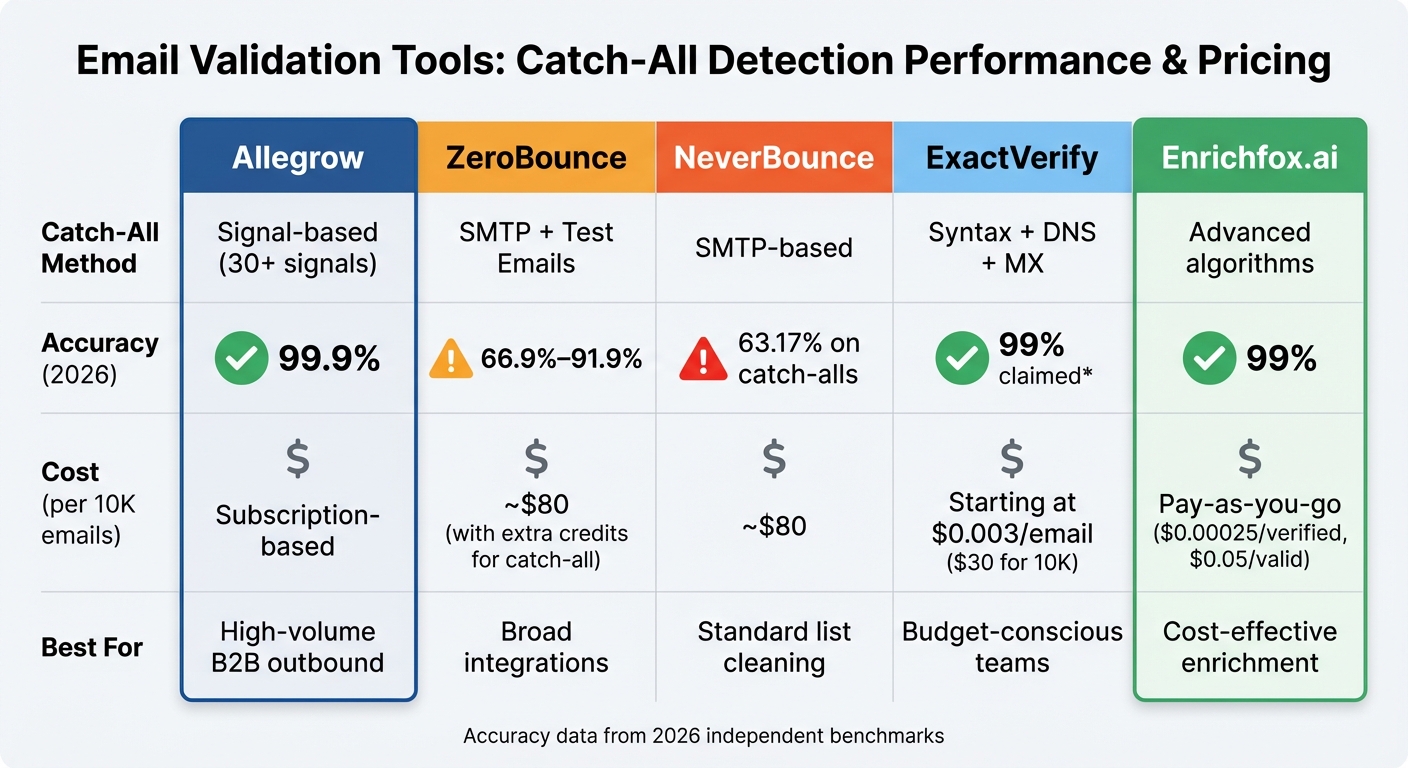
Email Validation Tools Comparison: Catch-All Detection Accuracy and Pricing
This section breaks down how each tool performs when dealing with catch-all emails, focusing on their strengths and limitations. These differences have a direct impact on error handling and the integrity of B2B leads, which are key issues discussed in this analysis.
Allegrow uses a signal-based system, analyzing over 30 infrastructure and engagement signals without sending test emails. It reached an impressive 99.9% accuracy with only a 0.1% false positive rate during 2026 testing. However, its subscription plans might not fit teams that only need occasional email validations. As Lucas Dezan, Demand Gen Manager at Allegrow, stated:
"Catch-all verification only pays off when the output is actionable and enforced where work happens. Labels parked in a spreadsheet won't protect sender reputation".
ZeroBounce offers extensive integration options and features like "Verify+", which sends test emails to catch-all addresses. However, this approach struggles with enterprise servers like Office 365 and Google Workspace, which often quarantine messages instead of bouncing them. According to Ruari Baker, CEO of Allegrow:
"Corporate 'catch-all' servers intentionally mask whether a specific mailbox actually exists... ZeroBounce struggled to navigate these defenses, producing an 8% false positive rate while missing 30% of real buyers".
Additionally, using its catch-all scoring requires extra credits, increasing costs by about 44%.
NeverBounce excels with high accuracy on standard domains but often labels catch-all addresses as "unknown" or "risky." This cautious approach reflects the challenges of distinguishing between valid and invalid catch-all responses. In 2026 tests, its accuracy on catch-all domains dropped from 99.1% to 63.17%. Pricing is around $0.008 per email for 10,000 emails.
ExactVerify claims 99% accuracy through its verify-segment-confirm workflow, which categorizes emails as valid, invalid, or risky in real time. Its flexible pricing starts at $0.003 per email on monthly plans, making it appealing for teams on tighter budgets. However, independent benchmarks for this tool are still limited.
Enrichfox.ai uses a pay-as-you-go model, charging $0.00025 per verified email and $0.05 per valid email found, with 99% accuracy in validation. It stands out for its ability to identify catch-all emails and offers features like bulk enrichment, API integrations, and CSV export options. These capabilities make it a cost-efficient choice for teams managing large B2B email lists.
Here’s a quick comparison of the tools and their trade-offs:
| Tool | Catch-All Method | Accuracy (2026) | Cost (per 10K emails or equivalent) | Best For |
|---|---|---|---|---|
| Allegrow | Signal-based (30+ signals) | 99.9% | Subscription | High-volume B2B outbound |
| ZeroBounce | SMTP + Test Emails | 66.9%–91.9% | ~$80 with extra credits for catch-all | Broad integrations |
| NeverBounce | SMTP-based | 63.17% (on catch-alls) | ~$80 | Standard list cleaning |
| ExactVerify | Syntax + DNS + MX | 99% (claimed) | Flexible, starting at $0.003/email | Budget-conscious teams |
| Enrichfox.ai | Advanced algorithms | 99% | Pay-as-you-go (e.g., $0.00025/verified, $0.05/valid) | Cost-effective enrichment |
The biggest challenge? Tools that fail to provide clear outcomes for catch-all emails leave 30% to 50% of B2B lists unresolved. This issue highlights the broader difficulties in validating catch-all emails, which are central to this analysis.
Conclusion
Validating catch-all emails continues to be a major hurdle in B2B lead management, especially since these addresses can make up anywhere from 30% to 50% of contact lists. To tackle this, various tools offer different approaches and pricing structures.
For teams managing high volumes of outbound emails, Allegrow stands out with its signal-based system designed specifically to address catch-all issues. Its subscription model makes it ideal for ongoing list maintenance. On the other hand, budget-conscious users might find Enrichfox.ai more appealing, thanks to its affordable pay-as-you-go pricing - $0.00025 per verified email and $0.05 per valid email found - combined with reliable catch-all detection.
Meanwhile, traditional validation tools like NeverBounce and ZeroBounce work well for standard email checks but often fall short with catch-all domains, frequently marking them as "unknown" or producing false positives during test email verifications. For those seeking a middle-ground option, ExactVerify offers a competitive pay-as-you-go model, though independent performance reviews of its capabilities are still limited.
FAQs
Why can’t catch-all emails be verified like normal emails?
Catch-all emails present a unique challenge when it comes to verification. Unlike standard email addresses, their mail servers are set up to accept messages for any address under the domain, whether it exists or not. This setup makes traditional SMTP verification methods ineffective, as they can't confirm if a specific inbox is real. To address this, alternative methods are necessary to validate catch-all emails with greater precision.
How should I handle “unknown” or “risky” catch-all addresses in my list?
To handle "unknown" or "risky" catch-all email addresses, it's important to identify and segment them carefully. This helps protect your sender reputation and ensures better email deliverability. Use specialized tools to verify whether these addresses are deliverable. If they're flagged as risky, consider suppressing them or placing them in a separate segment for targeted campaigns. Tools like Enrichfox.ai can assist with precise validation, giving you the insights needed to make smarter decisions. Managing these addresses effectively can lower bounce rates and protect your email reputation.
How often should I revalidate catch-all segments to protect deliverability?
To keep your email deliverability strong and protect your sender reputation, it's a good idea to recheck catch-all segments on a regular basis - ideally every month or quarter. Catch-all domains can often include invalid addresses or even spam traps, which, if ignored, can negatively impact the success of your email campaigns.