How Domain Segmentation Improves Lead Quality
Group contacts by email domain to validate and enrich data, reduce bounces, prioritize leads, and boost conversion with automated domain-based segmentation.
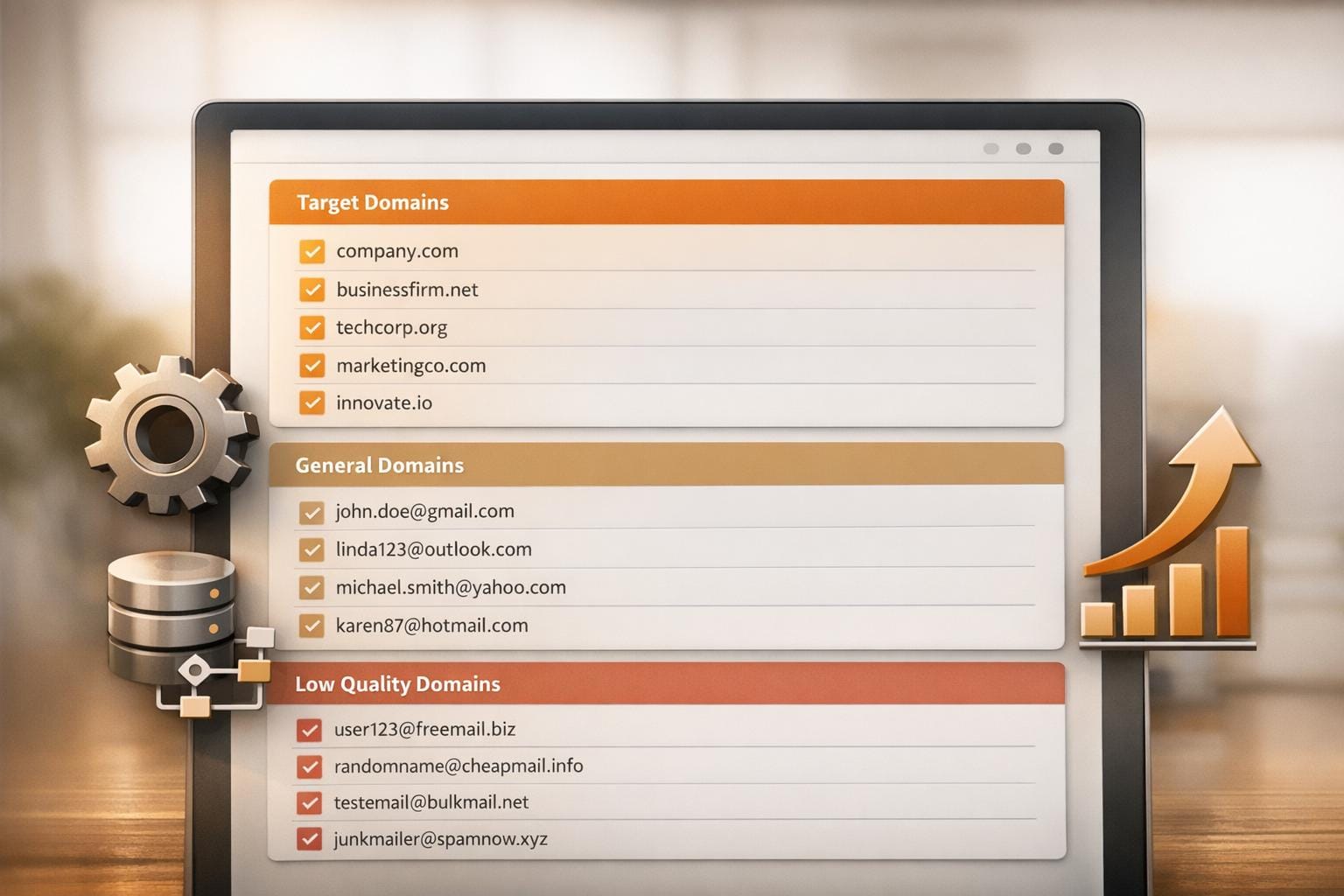
Domain segmentation is a data-driven strategy that improves lead quality by grouping contacts based on their email domains (e.g., @company.com) to focus on the company behind the contact. This approach shifts the focus from individuals to accounts, enabling businesses to:
- Target the right prospects: Use firmographic and technographic data to identify high-value accounts.
- Reduce wasted resources: Avoid outdated, invalid, or unqualified leads, cutting bounce rates and saving marketing budgets.
- Boost sales and marketing performance: Increase conversion rates by up to 355%, improve email engagement, and shorten sales cycles by 29%.
- Streamline workflows: Automate data validation, enrichment, and lead scoring for more efficient processes.
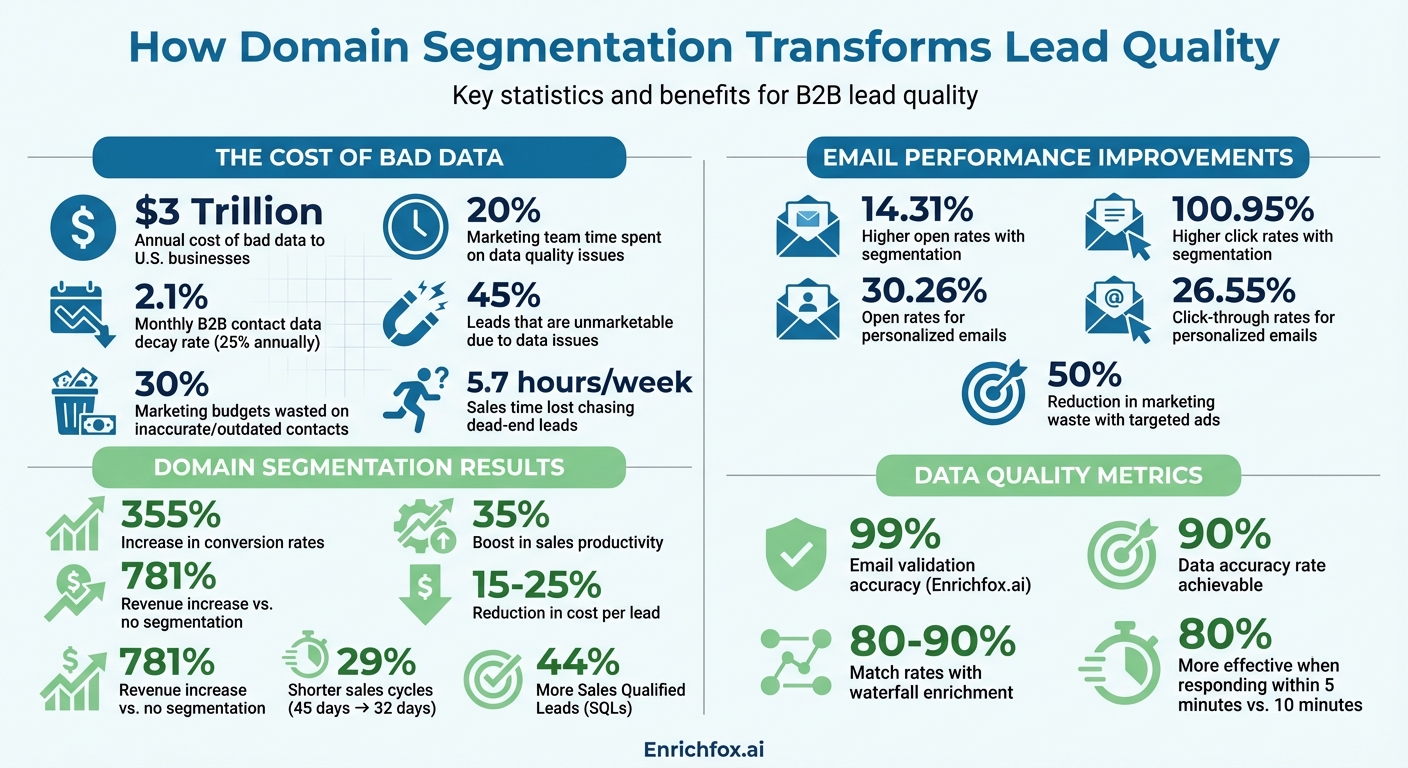
Domain Segmentation Impact: Key Statistics on Lead Quality and ROI
Find leads from domains with Lead Finder Domain Enrichment
Common Problems with Lead Quality
Low-quality leads can eat away at resources and drag down conversion rates. The tricky part? The underlying problems often stay hidden until you dig deeper into the data. This sets the stage for why domain segmentation can be a game-changer in addressing these inefficiencies.
Poor Targeting Leads to Low Conversions
When you use generic lead lists, you end up sending the same message to everyone - whether they’re startup founders or enterprise VPs. Unsurprisingly, this one-size-fits-all approach leads to clicks that don’t convert. According to the B2B Marketing Research Institute, improving data quality by just 15% boosted campaign performance by 28%, without any changes to the creative or targeting strategies.
Invalid Data Causes High Bounce Rates
Targeting isn’t the only issue - outdated contact details make the problem worse. Did you know that B2B contact data decays at a rate of 2.1% every month? That means a quarter of your database becomes outdated every year. Job changes, company relocations, and expired email addresses all contribute to this decay. Sending campaigns to inactive contacts drives up bounce rates, which can trigger spam filters and hurt your sender reputation. As a result, even legitimate emails might not make it to inboxes. To make matters worse, marketing teams often spend as much as 20% of their time dealing with these data quality headaches instead of focusing on actual campaigns.
Wasted Marketing Budget on Unqualified Leads
Bad data doesn’t just waste time - it drains money too. Up to 30% of marketing budgets are wasted on targeting inaccurate or outdated contacts. Sales teams lose an average of 5.7 hours per week chasing leads that go nowhere, and 45% of leads are unmarketable due to issues like insufficient data, duplicates, or other gaps. With 10% to 30% of B2B databases containing duplicate records, repeated outreach not only burns resources but also risks annoying potential prospects. If leads aren’t properly qualified and enriched, marketing efforts end up throwing money at contacts that were never a good fit to begin with. These inefficiencies make a strong case for domain segmentation as a way to improve lead quality and allocate resources more effectively.
What Is Domain Segmentation?
Domain segmentation is all about grouping contacts based on their email domains (like @company.com) rather than individual details. Instead of focusing on a single lead, this approach zeroes in on the company behind the domain. It shifts the question from "Who is this person?" to "What can their company tell us?" By doing so, businesses can gather account-level insights, paving the way for automated data enrichment and sharper targeting strategies.
Once you identify the domain, you can initiate a step-by-step process to gather more data. This involves querying multiple data providers to collect firmographic details (such as industry, revenue, and company size) and technographic information (like the software tools the company uses). Using multiple sources ensures a fuller picture, especially for smaller or niche companies that might be missed by a single provider.
How Domain Segmentation Works
Here’s how the process plays out: Start by pulling the email domain from each contact. That domain becomes the foundation for everything else. Instead of relying on outdated CRM entries or time-consuming manual research, automated tools use the domain to fetch up-to-date information about the company. This could include recent funding news, employee count, tech stack, or even growth trends.
This method shifts the focus from individual leads to account-level strategies. In B2B marketing, this is a game-changer because decisions rarely rest with just one person. By grouping contacts from the same domain, like @acmecorp.com, you get a comprehensive view of the entire organization rather than fragmented individual profiles. This approach underpins Account-Based Marketing (ABM), where you treat all stakeholders within a single domain as part of one unified account. It’s a direct solution to the problem of poor targeting and wasted marketing spend.
Why Domain Segmentation Improves Results
Domain segmentation can lead to conversion rate increases of up to 355%. The key lies in micro-segmentation - breaking broad categories like "Healthcare" into finer subsets such as "Medical Devices" or "Hospitals" based on company-specific data.
This level of precision enhances targeting. For example, if you know a company uses Salesforce or AWS (thanks to technographic data tied to their domain), you can tailor your messaging to align with their specific tech ecosystem. It’s no longer guesswork - you’re working with real-time data that shows whether a company is a good fit before you even reach out. Segmented email campaigns see 14.31% higher open rates and 100.95% higher click rates, while targeted advertising can cut marketing waste by as much as 50%.
How Domain Segmentation Fixes Lead Quality Problems
Domain segmentation addresses lead quality issues that drain budgets and hurt conversion rates by ensuring your outreach is targeted and relevant.
Group Leads by Industry Using Domain Data
Pulling a domain like @acmehospital.com allows for detailed industry classification that goes beyond a generic "Healthcare" label. With AI tools, you can analyze a company's website and content to place it into specific subcategories like "Hospitals", "Medical Devices", or "Healthcare SaaS". This level of detail is crucial - after all, the needs of a VP of Engineering at a Fortune 500 company differ vastly from those of a startup founder.
By segmenting leads this way, you can tailor your approach to meet the unique challenges of each industry. For example, a hospital system might prioritize HIPAA compliance and face lengthy procurement processes, while a medical device startup could be more focused on speed and scalability. This segmentation also allows you to assign leads to sales reps with relevant expertise and craft messaging that aligns with their specific business environments. And the payoff? Companies that implement effective segmentation have seen conversion rates soar by up to 355% and revenue jump by 781% compared to those using minimal or no segmentation.
Once leads are grouped accurately, the next step is to ensure their contact details are both valid and comprehensive.
Validate and Enrich Contact Information
The process starts with validation, followed by enrichment - an order that’s critical. Email validation eliminates fake addresses, outdated contacts, and risky "catch-all" domains, saving your marketing dollars from being wasted. Tools like Enrichfox.ai can validate emails with 99% accuracy and identify catch-all domains for just $0.00025 per email.
After validation, enrichment takes over, transforming a clean email address into a complete prospect profile. For instance, the domain @techstartup.com could reveal details like company size, recent funding, key technologies, and headquarters location. Sequential enrichment, which uses multiple data providers to fill in gaps, is especially useful for smaller companies that single-source tools might miss. The benefits are clear: businesses using data enrichment report a 35% boost in sales productivity and a 30% reduction in cost per lead.
This enriched data feeds directly into a lead scoring system, ensuring your team focuses on the right prospects.
Score and Prioritize Leads More Accurately
With enriched data in hand, accurate lead scoring becomes possible. This approach combines three key dimensions: Fit (does the lead align with your Ideal Customer Profile?), Intent (are they showing buying signals?), and Engagement (are they interacting with your emails or website?). For example, a lead from a 500-person SaaS company actively researching your product category will score higher than an individual consultant using a generic email address.
In practice, leads scoring 85+ points might trigger immediate sales outreach. Those scoring 60–84 points could enter targeted marketing campaigns, while leads in the 40–59 range might receive educational content. Leads scoring below 40 could either be monitored or removed from active campaigns. This tiered system ensures your team focuses its efforts where they’ll have the most impact. Teams using data-driven lead scoring are 1.7 times more likely to grow their market share. Plus, personalized emails built on segmented data achieve open rates of 30.26% and click-through rates of 26.55% - far outperforming generic email blasts.
With prioritized leads in hand, your sales team can execute targeted outreach strategies that deliver measurable results.
How to Implement Domain Segmentation
Domain segmentation can be broken down into three key steps: organizing your existing data, enriching and validating it, and finally, integrating it with your marketing tools. These steps will help you transform raw data into actionable lead profiles.
Step 1: Review and Organize Your Lead Lists
Start by gathering all your lead data from your CRM or marketing automation platform, whether it’s Salesforce, HubSpot, or another tool. You’ll need data such as engagement metrics (email opens, clicks, website visits), firmographic details (company size, revenue, location), and behavioral signals (content downloads, demo requests). The idea is to centralize everything so you can identify patterns and gaps.
Next, define your segmentation criteria. Focus on key firmographic markers like industry, company size, geographic location, and revenue range. For instance, if your target audience includes mid-sized SaaS companies in healthcare, you’d segment by industry (Healthcare SaaS), company size (50-500 employees), and possibly funding stage.
While reviewing your lists, you’ll likely notice missing information - like job titles or direct phone numbers. This is common. CRM data can become outdated over time without regular updates. Take note of these gaps, as they’ll guide your next steps for data enrichment.
To refresh your lists, consider bulk CSV uploads. For example, in 2024, Darwinbox’s sales team achieved a 90% data accuracy rate for U.S. contacts and added 15,000 new contacts by using Cognism’s enrichment tools. This allowed them to precisely segment and target the North American market.
Step 2: Validate Data with Enrichment Tools
Once your data is organized, the next step is to clean and enhance it. Start with validation - this means removing fake emails, outdated contacts, and catch-all domains before you invest in outreach. Tools like Enrichfox.ai offer email validation with 99% accuracy for just $0.00025 per email, making it cost-effective to process large datasets.
After validation, use enrichment tools to fill in any missing details. Upload your cleaned list to an enrichment platform, and it will append firmographic data such as company size, industry classification, revenue estimates, and headquarters location. This turns a simple email address into a detailed prospect profile, ready for segmentation.
For better results, try a waterfall enrichment approach. This method queries multiple data providers in sequence. If one provider lacks the required data, the query moves to the next, boosting match rates from 50-60% (typical for single-source tools) to 80-90% or higher.
To keep your data current, schedule weekly or monthly enrichment updates. Real-time enrichment can also be a game-changer. For example, responding to leads within 5 minutes is 80% more effective than waiting 10 minutes. Real-time updates ensure your team always has the latest information as new leads enter the system.
Once your data is validated and enriched, it’s time to integrate it into your marketing stack.
Step 3: Connect Enriched Data to Your Marketing Tools
The final step is to integrate your enriched data into your CRM or marketing automation platform. Most enrichment tools offer direct API connections to platforms like HubSpot, Salesforce, and Marketo, streamlining the process and eliminating the need for manual uploads.
Set up automated lead scoring and routing using the enriched data. For example, leads from SaaS companies with 500+ employees in your target industries could automatically receive higher scores and be routed to senior sales reps, while smaller companies might enter nurture campaigns. You can also set SLA timers to notify your team if a high-priority lead hasn’t been contacted within 60 minutes.
When integrating, carefully map your lead fields to avoid duplicate records and ensure smooth data flow from capture to conversion. Standardize values during this process - for example, converting abbreviations like "CT" to "Connecticut" or normalizing job titles like "Content Marketing Manager" into broader categories. This ensures your segmentation and routing logic functions as intended.
"Default allows you to route leads based on form input and enrichment by other tools like Clearbit and Apollo... we no longer need to stitch 5 tools together to get the job done." - Jules J., Verified G2 Reviewer
Companies that maintain properly enriched CRM data generate 44% more Sales Qualified Leads (SQLs). To sustain these results, appoint data stewards to monitor data quality, track enrichment performance, and ensure segmentation criteria align with your evolving business goals. With this integration in place, your team will have the accurate, actionable data they need to improve lead quality and drive better results.
Enrichfox.ai vs. Other Enrichment Tools
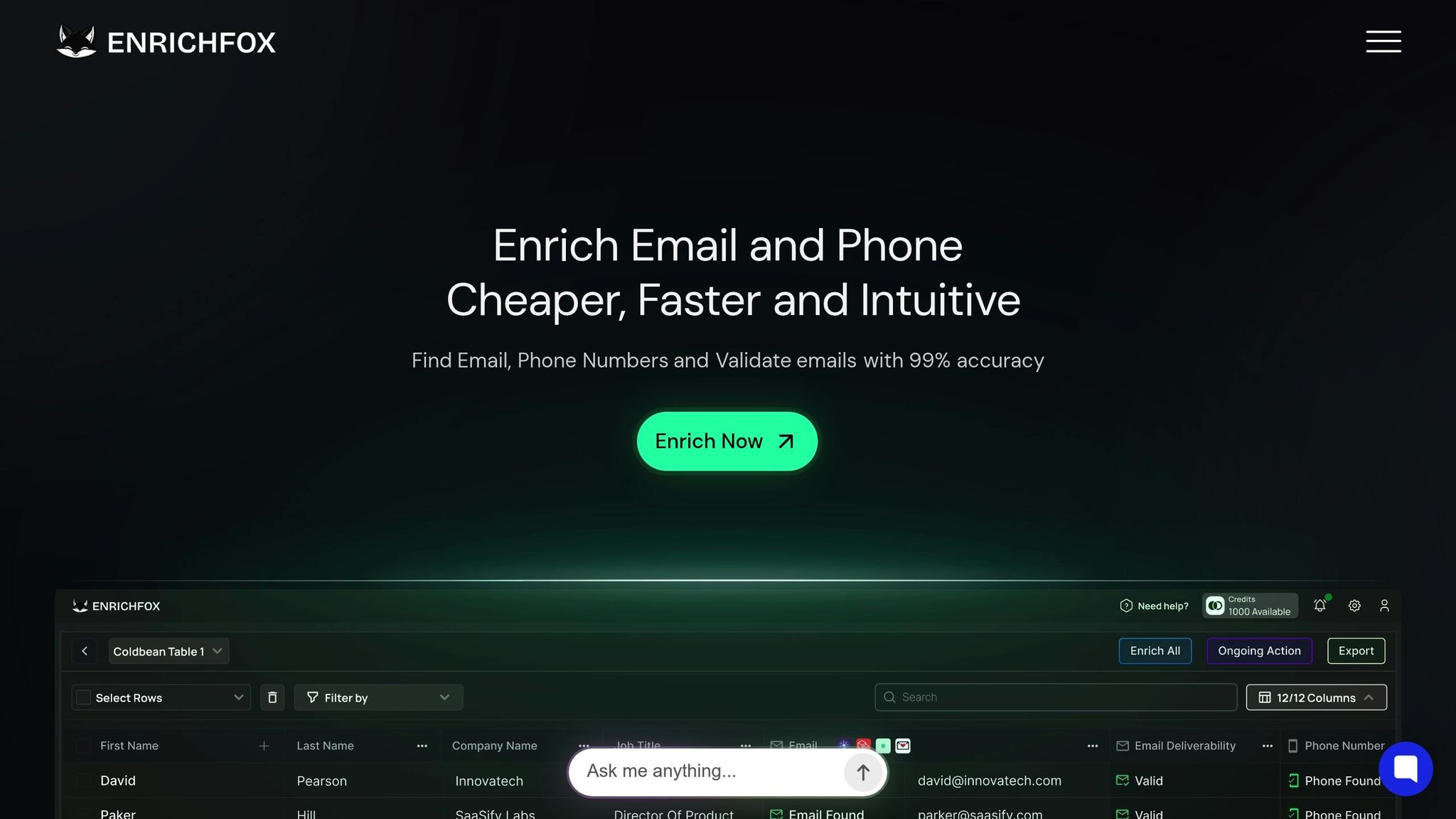
Picking the right enrichment tool can make or break your domain segmentation efforts. While data quality is crucial, factors like cost and accuracy also play a big role in determining the best platform for your needs. Enrichfox.ai stands out with its pay-as-you-go model, charging just $0.00025 per validated email. This straightforward pricing structure sets it apart from competitors that often rely on custom pricing. Plus, with a 99% email validation accuracy, Enrichfox.ai ensures your outreach efforts hit the mark, even when working with large lead lists.
Another standout feature is its ability to detect catch-all emails, which is a common hurdle in email validation. Since catch-all domains accept all incoming emails, pinpointing valid addresses can be tricky. Enrichfox.ai addresses this challenge effectively, offering precise data enrichment without breaking the bank.
Feature and Pricing Comparison
| Platform | Pricing | Bulk Enrichment | API and Webhook Support | Catch-All Detection |
|---|---|---|---|---|
| Enrichfox.ai | $0.00025–$0.05 per email | Yes | Yes | Yes |
| Apollo | Pricing varies | Yes | Yes | No |
| ZoomInfo | Custom Pricing (typically high) | Yes | Yes | No |
| Clay | Custom Pricing | Yes | Yes | No |
While platforms like ZoomInfo offer extensive CRM integrations, they often come with complex setups and lengthy implementation timelines - anywhere from 3 to 6 months. In contrast, Enrichfox.ai provides fast and easy integration through its API and webhook support, delivering quicker results with transparent pricing.
Results and Best Practices
Using domain segmentation can lead to some impressive outcomes: 20–30% higher conversion rates, revenue increases of up to 760%, and sales cycles that are 29% shorter - dropping from 45 days to an average of 32 days. When combined with data enrichment, sales productivity can see a 35% boost, while the cost per lead drops by 15–25%.
"Bad data costs U.S. businesses $3 trillion per year. When your data is wrong, your decisions are wrong." - Thomas C. Redman, "The Data Doc"
To truly see these benefits, it's essential to track performance with the right metrics.
Metrics to Track
Here are some key indicators that show improvements in lead quality:
- Email open rates: Aim for a range of 15–25%.
- Click-through rates: A solid target is 2–5%.
- MQL to SQL conversion rate: Lead scoring and intent signals can drive this 79% higher than the baseline.
- Bounce rates by segment: Focus on bounce rates within specific segments rather than overall averages to pinpoint data quality issues early and protect sender reputation.
- Data accuracy: Keep key fields at least 95% complete to ensure reliable data.
Tips for Maintaining Lead Quality
Data doesn’t stay fresh forever - about 25% of it becomes outdated every year. Keeping your database accurate and effective requires regular upkeep. By leveraging automated tools and processes, you can minimize manual work while maintaining high-quality leads.
Start by implementing real-time validation through APIs that refresh your data as it’s captured. Tools like Enrichfox.ai simplify this with webhook integrations that automatically validate and enrich incoming leads, ensuring your data remains up-to-date.
Additionally, conduct quarterly reviews of your segmentation criteria to stay aligned with market changes. Regularly standardize data formats to eliminate duplicates - ensuring terms like "CEO" and "Chief Executive Officer" are treated the same. For a fuller view of your customers, combine multiple data sources, including firmographic, technographic, and intent data. This layered approach, coupled with tools that detect catch-all emails (like those from Enrichfox.ai), helps maintain a high standard of lead quality without requiring extensive manual effort.
Conclusion: Domain Segmentation for Better Lead Quality
Domain segmentation takes the guesswork out of lead management by using data to group prospects based on industry, tech stack, and firmographic details. This targeted approach can significantly boost conversion rates and revenue. In fact, sales cycles can be shortened by approximately 29%.
With these advantages in mind, modern workflows increasingly rely on automation. Traditional methods often waste valuable time, but automating tasks like data validation, contact enrichment, and lead scoring ensures your team spends more time on meaningful conversations with prospects who are ready to take action.
Platforms like Enrichfox.ai make this process straightforward. With features like real-time validation, webhook integrations, and an impressive 99% email accuracy rate, it delivers reliable results. At just $0.05 per valid email and $0.03 per phone number, Enrichfox.ai is a cost-effective alternative to pricier enterprise solutions. Its ability to identify catch-all emails and validate phone numbers ensures your outreach reaches the right decision-makers.
Over time, maintaining high-quality, enriched lead data becomes a cornerstone for growth. It enhances marketing efficiency and boosts sales productivity. By continuously refining segmentation criteria and keeping your data up-to-date, you create a sustainable edge over the competition.
Reassess your Ideal Customer Profile regularly and use automated enrichment tools to keep your information accurate. Domain segmentation streamlines the entire process of identifying, qualifying, and converting leads, setting your team up for consistent success with high-quality prospects.
FAQs
What makes domain segmentation better than traditional lead targeting?
Domain segmentation zeroes in on grouping leads by their domain - essentially their email or website address - ensuring everyone in the segment comes from the same company or shares a similar industry background. This method allows marketers to craft messaging and offers that feel more relevant and personalized, which naturally leads to better engagement and higher conversion rates.
On the other hand, traditional lead targeting typically uses broader filters like industry, company size, or geographic location. While this approach can work, it often lumps together businesses that don’t have much in common. Domain segmentation fixes this by focusing on the domain level, offering a sharper, more efficient way to target leads. The result? Better lead quality and stronger marketing performance.
How does domain segmentation help improve lead quality?
Domain segmentation sharpens lead quality by zeroing in on prospects who are more likely to convert. This approach enables personalized outreach and boosts marketing efficiency. By categorizing leads based on factors like industry, company size, or other domain-specific characteristics, businesses can craft messages and offers that truly connect with their audience.
This level of precision doesn’t just speed up the sales process - it also opens doors for upselling and cross-selling opportunities. In fact, companies leveraging domain segmentation have seen conversion rates soar by as much as 355%, alongside notable revenue increases when compared to more traditional methods. Tools such as Enrichfox.ai make this process even smoother by offering accurate data enrichment, ensuring your lead lists are both trustworthy and ready for action.
What is the best way to implement domain segmentation to improve lead quality?
Domain segmentation is all about grouping leads based on their company’s domain, such as *.edu or *.gov, or even industry-specific domains. This approach allows businesses to craft marketing strategies that align with the unique needs of each group. By delivering personalized messages that resonate with a lead's domain, companies can see a noticeable uptick in conversion rates and attract higher-quality leads.
To pull off domain segmentation successfully, start with reliable data enrichment and validation. A tool like Enrichfox.ai can help here, offering 99% accuracy when it comes to email and phone number verification. Once your data is in good shape, define your segmentation criteria by combining domain details with other insights like firmographics, behavioral trends, and technographics. Automating this process using a CRM or marketing platform ensures leads are assigned to the right segments in real time. From there, focus on creating tailored content for each segment and keep an eye on performance metrics to fine-tune your strategy.
What makes Enrichfox.ai a standout option? It excels at detecting catch-all emails and validating phone numbers, giving it an edge over competitors like Apollo, ZoomInfo, and Wiza. For U.S.-based marketing and sales teams, this means segmentation efforts that are not only accurate but also scalable and efficient.