GDPR Compliance For Contact Data Enrichment
GDPR must dictate how you enrich contact data—use legitimate interest, minimize fields, enforce DPAs, and apply short retention to reduce regulatory risk and data decay.
GDPR compliance is non-negotiable for businesses enriching contact data. Whether you're sourcing emails, phone numbers, or job titles for B2B prospecting, the General Data Protection Regulation (GDPR) applies if you're handling data from individuals in the European Union. Non-compliance risks hefty fines (up to €20 million or 4% of global revenue) and operational setbacks like reduced email deliverability or domain blacklisting.
Here’s what you need to know to stay compliant:
- Legal Basis: Use "Legitimate Interest" as your legal basis, backed by a Legitimate Interest Assessment (LIA). Notify individuals about data collection and processing within one month.
- Data Minimization: Only gather essential data. Avoid unnecessary fields like social media profiles unless strictly required.
- Accuracy: Regularly refresh and verify data to maintain quality, as B2B data decays quickly (e.g., emails decay 25–30% annually).
- Security Measures: Encrypt data, use multi-factor authentication, and restrict access with role-based controls.
- Retention Policies: Delete or anonymize inactive contact data after three years to align with GDPR guidelines.
- Vendor Compliance: Sign Data Processing Agreements (DPAs) with enrichment tools and ensure vendors meet GDPR standards.
Using GDPR-compliant tools like Dropcontact (real-time processing) or Cognism (EU-focused) can help you maintain compliance while improving data accuracy. Regular audits, clear documentation, and transparent practices are key to avoiding fines and building trust with your audience.
GDPR Principles for Contact Data Enrichment
Lawfulness, Transparency, and Fair Processing
When engaging in contact data enrichment, it's crucial to ensure your actions align with the legal requirements of Article 6 of the GDPR. For B2B prospecting, many businesses rely on Legitimate Interest (Article 6.1(f)) as their legal basis. To meet this standard, you’ll need to conduct a Legitimate Interest Assessment (LIA). This involves clarifying your business purpose (e.g., growing revenue), demonstrating that processing the data is necessary, and confirming that your interests don’t override the rights of individuals. Professional data - like work email addresses - generally carries less privacy risk than personal data, which can help satisfy the LIA criteria.
"The processing of personal data for direct marketing purposes may be regarded as carried out for a legitimate interest." - GDPR Recital 47
If you’re sourcing data from third parties, such as enrichment platforms or LinkedIn, Article 14 requires you to notify the individual. This notification must occur either at the first point of contact or within one month. Your outreach should clearly disclose the data source, the legal basis for processing, and include a simple way for recipients to opt out, like a one-click unsubscribe link. It’s worth noting that failing to establish a valid legal basis is a common reason for GDPR penalties. In 2024 alone, regulators issued 73 fines for this issue, with France's CNIL conducting over 340 audits targeting improper prospecting practices.
Once your legal basis is in place, the next step is to focus on minimizing and verifying the data you collect.
Data Minimization and Accuracy Requirements
Adhering to GDPR principles not only ensures compliance but also helps reduce the risk of data breaches by limiting unnecessary data collection.
The principle of data minimization requires that you collect only information that is "adequate, relevant, and limited to what is necessary." For instance, if your sales process only requires a first name and a professional email address, adding extra details like social media profiles or technographic data may be unnecessary. Configure your enrichment tools to gather only the essential fields, following the Privacy by Design approach to limit data storage.
Accuracy is equally important. The GDPR mandates that personal data must be accurate and kept up to date. Any inaccuracies should be corrected or removed promptly. This is particularly relevant in B2B settings, where data tends to become outdated quickly. For example, job titles can change at a rate of 30–35% per year, and professional email addresses can decay by 25–30% annually.
| Data Point | Annual Decay Rate | Typical Accuracy (Waterfall Enrichment) |
|---|---|---|
| Work Email | 25–30% | 92–98% |
| Job Title | 30–35% | 88–95% |
| Direct Dial Phone | 20–25% | 70–85% |
| Company Name | 5–10% | 95–99% |
To maintain high-quality data, schedule regular refresh cycles to re-verify enriched information every 6 to 12 months. Use tools like SMTP checks to validate email addresses before adding them to your database. Additionally, consider deleting inactive prospect records three years after the last interaction to keep your database clean and compliant.
How to Ensure GDPR Compliance
Managing Consent for Contact Data
When it comes to enriching B2B contact data, most businesses rely on Legitimate Interest under Article 6(1)(f) instead of explicit consent. To stay compliant, you’ll need to document this reasoning with a Legitimate Interest Assessment (LIA). This should detail your business purpose, why enrichment is necessary, and a balancing test that demonstrates how professional contact data poses a lower privacy risk.
"The processing of personal data for direct marketing purposes may be regarded as carried out for a legitimate interest." - GDPR Recital 47
Under Article 14, if you’re using third-party data, you’re required to inform individuals at the first point of contact. This means your initial outreach must include key details such as your company’s identity, the purpose of processing, the legal basis, the data source (e.g., "sourced from LinkedIn"), and a one-click unsubscribe option. Make sure withdrawing consent is just as easy as giving it, with one-click options available on all communication channels.
You’ll also need to sign a Data Processing Agreement (DPA) with any data enrichment vendors. This agreement should clearly outline security responsibilities and permissible data usage. To meet GDPR’s Article 30 requirements, maintain a Record of Processing Activities (ROPA) that tracks data categories, sources, retention timelines, and security measures.
Once consent and documentation are in place, your next focus should be on safeguarding the data with strong technical and organizational measures.
Technical and Organizational Security Measures
GDPR’s Article 32 requires you to implement security measures that are appropriate to the level of risk. This includes encrypting data both in transit and at rest, using multi-factor authentication (MFA) for access, and applying role-based access control (RBAC) to limit who can modify data. You can also use data seeding techniques to detect and track unauthorized data usage.
On the organizational side, regular staff training is critical. Ensure employees are well-versed in data protection policies, how to handle sensitive information, spot phishing attempts, and report incidents. Additionally, establish incident response plans and maintain visitor logs for physical access to data centers.
"Human error remains one of the leading causes of data breaches. Provide regular training to staff on data protection policies, handling sensitive information, recognizing threats like phishing attempts, and incident reporting procedures." - Dwayne Morgan, Ambit Compliance
If a data breach occurs, you must notify the Data Protection Authority within 72 hours if the breach poses a risk to individual rights. Failing to comply with security requirements can lead to steep penalties. Fines can range from $10.9 million or 2% of global turnover for minor breaches to $21.8 million or 4% of turnover for more serious violations.
Compliance Audits and Monitoring
Staying compliant isn’t a one-time task - it requires ongoing audits to ensure you’re keeping up with GDPR standards. For instance, in 2024, France’s CNIL conducted over 340 audits and issued numerous fines related to data handling and prospecting. Companies that invest in privacy protections not only avoid fines but also save an average of $2.3 million per year in legal costs.
To meet GDPR’s retention guidelines, set automated rules in your CRM to delete or anonymize prospect data after 36 months of inactivity. GDPR recommends keeping unresponsive prospect data for no longer than 3 years from the last contact. Additionally, maintain a centralized suppression list that syncs across all communication channels (e.g., email, LinkedIn, phone) to ensure opted-out individuals are never re-contacted or re-enriched.
Regularly review your enrichment vendors to confirm they have up-to-date DPAs, valid security certifications, and current compliance documentation. If you’re using US-based tools to process EU data, make sure they are certified under the EU‑US Data Privacy Framework or use Standard Contractual Clauses (SCCs). Conduct quarterly ROPA reviews to ensure it accurately reflects all current processing activities and retention policies. These proactive measures can significantly reduce the risk of data breaches.
Dropcontact: GDPR-Compliant Contact Enrichment
Selecting GDPR-Compliant Enrichment Tools
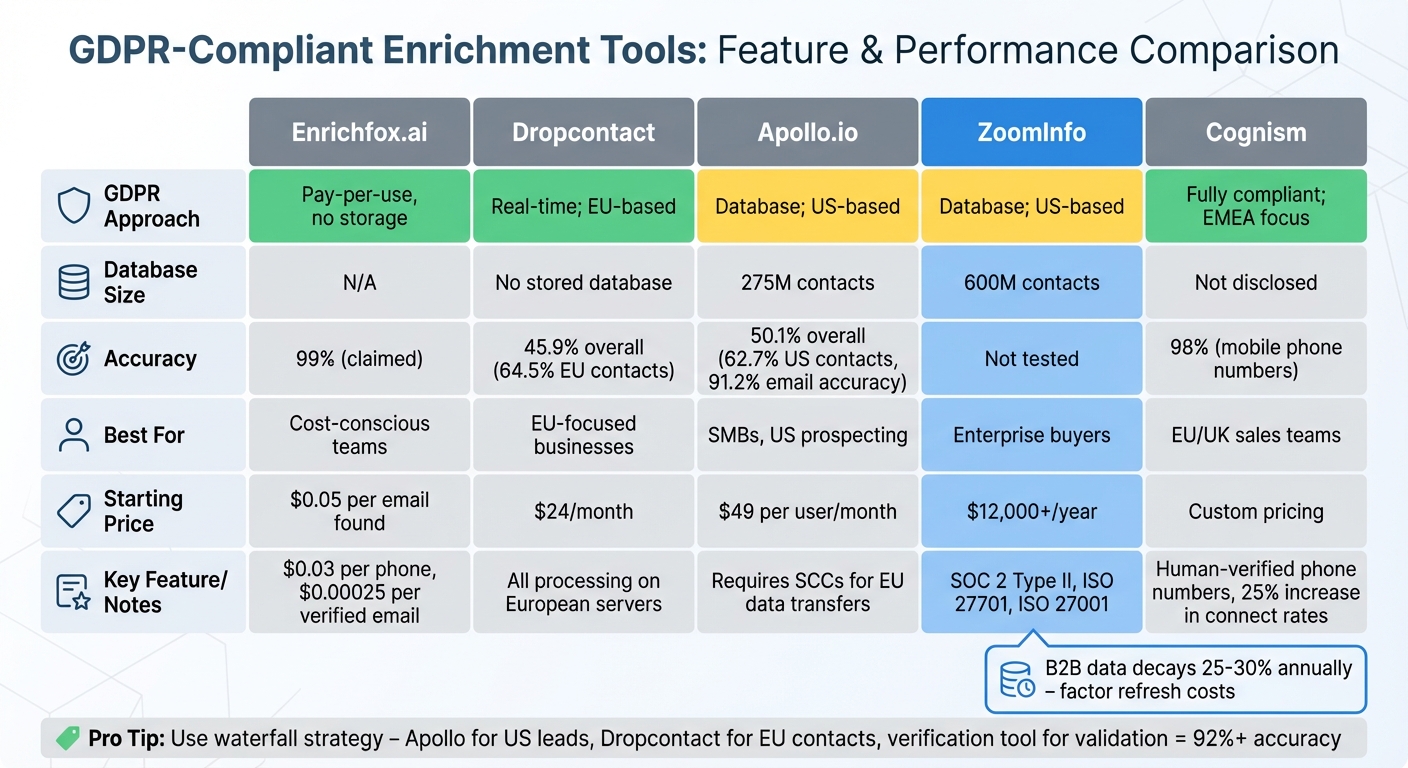
GDPR-Compliant Contact Data Enrichment Tools Comparison
Required Features in Enrichment Tools
When it comes to GDPR-compliant enrichment tools, picking the right platform isn't just a matter of convenience - it's essential for staying on the right side of data privacy laws.
Start by ensuring the platform provides a signed Data Processing Agreement (DPA). This document should outline how data is handled, list sub-processors, and describe breach notification protocols. Additionally, the tool needs to support Legitimate Interest under Article 6(1)(f) of the GDPR. Look for documented assessments and detailed, time-stamped consent logs that include the language used and the IP address.
The tool should also enable the Right to Erasure, meaning it must permanently delete subscriber data instead of merely unsubscribing or soft-deleting contacts. Data minimization is another critical feature - your tool should allow you to enrich only the fields you need, avoiding unnecessary data collection. If the tool handles cross-border data, verify that it uses Standard Contractual Clauses (SCCs) or has an adequacy decision in place for data stored outside the EU. Lastly, suppression list management is a must to ensure opted-out individuals are not re-contacted or re-enriched.
For added peace of mind, look for tools with third-party security certifications like SOC 2 Type II or ISO 27001. These certifications validate that the vendor has strong technical and organizational measures for data access and handling.
Tool Comparison: Enrichfox.ai vs. Competitors
The enrichment tool market is divided into two main types: database-driven platforms that store vast contact repositories and real-time tools that generate data on demand. These differences directly affect GDPR compliance and breach risks.
Dropcontact operates with real-time algorithms, avoiding stored databases entirely. This design ensures full GDPR compliance, with all processing confined to European servers. For EU businesses, this eliminates data residency concerns. In a 2026 blind test with 5,000 leads, Dropcontact achieved 64.5% accuracy for EU contacts, outperforming its 29.4% accuracy for US contacts. Apollo, by comparison, achieved 62.7% accuracy for US leads.
On the other hand, Apollo.io and ZoomInfo rely on large, stored databases - 275 million and 600 million contacts, respectively. As US-based companies, EU businesses using these tools need to ensure SCCs are in place for data transfers. Apollo offers a free tier and paid plans starting at $49 per user per month, making it an affordable choice for small and medium-sized businesses. However, its accuracy testing revealed a 50.1% verified valid rate overall, with email accuracy at 91.2%, slightly below its claimed 95%+. ZoomInfo, meanwhile, caters to enterprise clients with pricing starting at $12,000 annually and boasts certifications like SOC 2 Type II, ISO 27701, and ISO 27001.
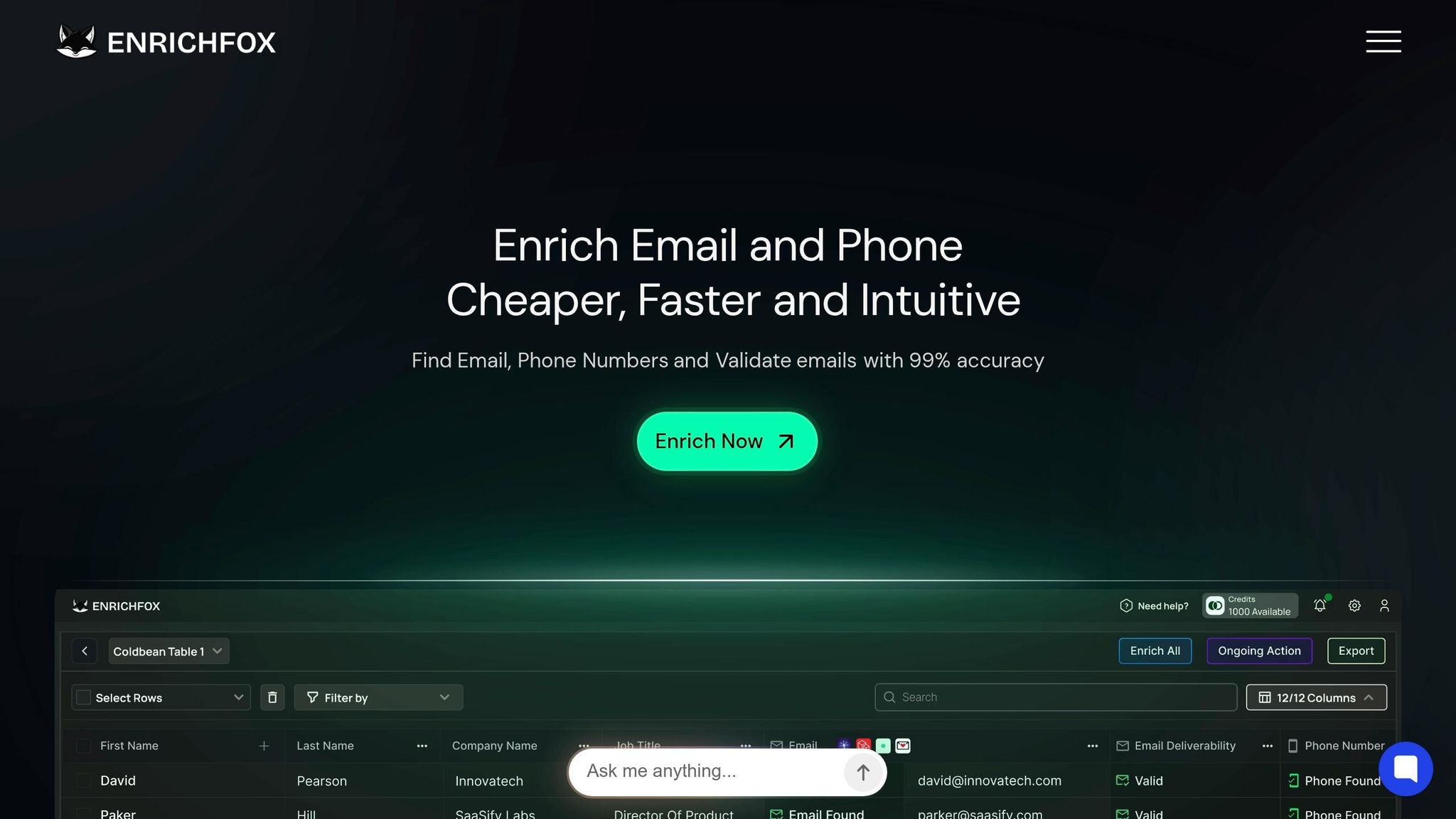
Enrichfox.ai takes a different approach with its pay-as-you-go model. It claims 99% accuracy for email validation, charging $0.05 per valid email, $0.03 per valid phone number, and $0.00025 per verified email. This pricing structure is ideal for teams with occasional enrichment needs.
For businesses targeting the EU market, Cognism stands out. It specializes in GDPR-compliant mobile data, offering human-verified phone numbers with 98% accuracy. Fully compliant with GDPR and CCPA, it's a strong choice for European and UK-focused sales teams.
"Cognism's verified phone numbers increased our connect rate by 25% quarter-over-quarter. We also have less bounces and more DIDs that lead to conversations compared to Apollo or ZoomInfo." - John Pennypacker, VP of Sales and Marketing at Deep Cognition
For companies operating across multiple regions, a waterfall strategy can be effective. For example, use Apollo for US leads, Dropcontact for EU contacts, and a verification tool like NeverBounce to catch false positives. This layered approach can push valid email discovery rates as high as 92%. Sticking to outdated or non-compliant tools not only increases breach risks but also undermines the safeguards GDPR requires.
| Tool | GDPR Approach | Database Size | Accuracy (Overall) | Best For | Starting Price |
|---|---|---|---|---|---|
| Enrichfox.ai | Pay-per-use, no storage | N/A | 99% (claimed) | Cost-conscious teams | $0.05 per email found |
| Dropcontact | Real-time; EU-based | No stored database | 45.9% (64.5% EU) | EU-focused businesses | $24/month |
| Apollo.io | Database; US-based | 275M contacts | 50.1% (62.7% US) | SMBs, US prospecting | $49 per user/month |
| ZoomInfo | Database; US-based | 600M contacts | Not tested | Enterprise buyers | $12,000+/year |
| Cognism | Fully compliant; EMEA focus | Not disclosed | 98% (mobile) | EU/UK sales teams | Custom pricing |
Before making a decision, request documentation that confirms the data was sourced transparently, such as from public records or opt-in databases. Review the DPA to check for GDPR compliance across all sub-processors. And don’t overlook the fact that email databases decay at an average rate of 30% annually - factor in ongoing data refresh costs when estimating total expenses.
Conclusion
Key Takeaways for Businesses
GDPR compliance isn't a roadblock - it’s a way to make your prospecting efforts stronger and more reliable. B2B data falls under the umbrella of personal data, so every enrichment activity needs a clear legal basis, typically grounded in Legitimate Interest and supported by a formal assessment.
To ensure your enrichment process is compliant, focus on three core principles: transparency, minimization, and accountability. Be upfront about your data sources in outreach (e.g., "I found your details on LinkedIn"), limit enrichment to only the fields you truly need, sign a Data Processing Agreement with all vendors, and enforce a 3-year retention policy to either anonymize or remove inactive contacts. This approach doesn’t just keep you compliant - it also helps maintain data accuracy in a market where 25–30% of B2B contacts become outdated every year. Plus, it could save your business up to $2.3 million annually by avoiding fines and legal troubles.
"GDPR compliance in B2B data enrichment isn't a blocker - it's a framework that makes your prospecting more durable and more effective." - Jonathan Maurin, Derrick App
Choosing the right enrichment tool is just as important. Opt for GDPR-compliant tools with certifications like SOC 2 Type II or ISO 27001. These tools should provide transparent sourcing and simple opt-out options. Using a waterfall enrichment strategy can help you achieve up to 98% accuracy while maintaining broad coverage and compliance across multiple providers. Keep in mind: poor data quality can cost businesses up to $15 million annually.
Finally, document everything. Maintain a Record of Processing Activities (ROPA) as required by Article 30, and conduct quarterly database audits. When your processes, tools, and records align with GDPR, compliance transforms into a competitive edge. Companies that embrace GDPR build trust, improve deliverability, and protect their bottom line - all while staying ahead of the curve.
FAQs
Do I need consent to enrich B2B contact data under GDPR?
Under the GDPR (General Data Protection Regulation), you typically need explicit consent to enhance B2B contact data, especially when dealing with personal details like email addresses or phone numbers. It's crucial to follow GDPR guidelines carefully to avoid violations and the risk of fines.
What should an Article 14 notice include for third-party prospect data?
When sending an Article 14 notice about third-party prospect data, it's essential to include several key details. These include the identity and contact information of the data controller, the purposes and legal basis for processing the data, the categories of personal data being handled, the recipients of the data, and whether there are any transfers to third countries or international organizations. Including this information ensures compliance with GDPR and promotes transparency.
How long can I keep enriched prospect data before deleting it?
To ensure compliance with GDPR guidelines, enriched prospect data should be retained only for as long as it serves the purpose for which it was originally collected. Make it a habit to regularly review your stored data and remove anything that's no longer necessary. This not only reduces potential risks but also promotes better data management practices.