Top 10 Lead Enrichment Tools: Pricing Breakdown
Pricing, accuracy, and feature breakdown of 10 lead enrichment tools—from pay-per-result options to enterprise plans—to inform budget and workflow choices.

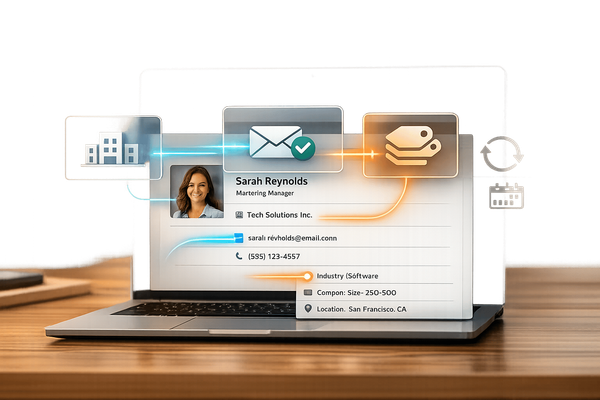
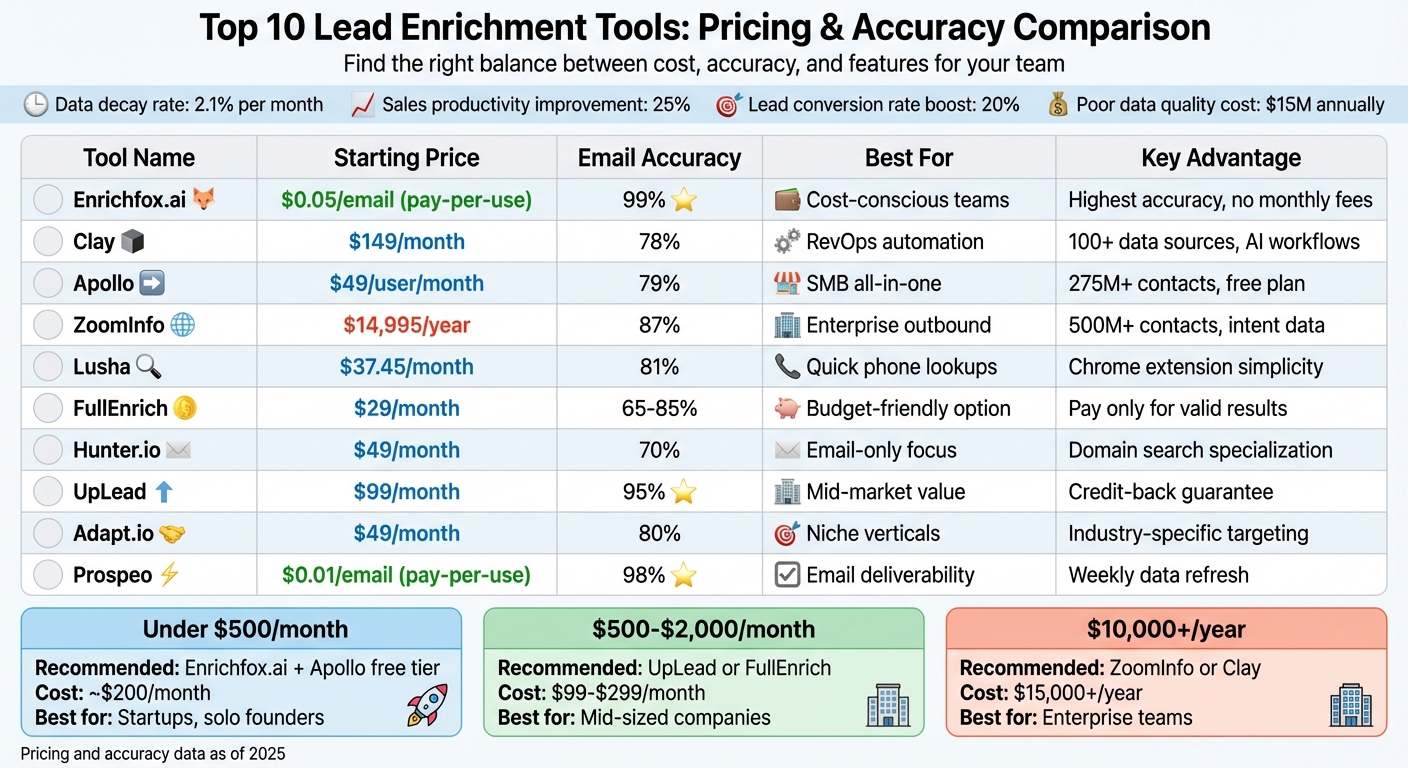
Lead enrichment tools help you fill missing contact details like emails, job titles, and phone numbers. With data decaying at 2.1% per month, businesses lose millions annually due to poor-quality leads. These tools save time, improve sales productivity by 25%, and boost lead conversion rates by 20%. Pricing varies from pay-per-use models starting at $0.05 per email to enterprise plans exceeding $15,000/year. Here's a quick breakdown of the top 10 tools:
- Enrichfox.ai: Pay-per-result, $0.05/email, 99% accuracy.
- Clay: Credit-based, $149–$800/month, AI workflows, 78% email accuracy.
- Apollo: Starts at $49/user/month, 79% email accuracy, free plan available.
- ZoomInfo: Enterprise-level, $14,995+/year, 87% email accuracy.
- Lusha: $37.45–$299.95/month, credit-based, 81% accuracy.
- FullEnrich: $29/month, pay-for-success, 65–85% match rates.
- Hunter.io: $49/month, email-focused, 70% accuracy.
- UpLead: $99/month, 95% email accuracy, credit-back guarantee.
- Adapt.io: $49/month, niche targeting, 80% accuracy.
- Prospeo: Pay-per-success, $0.01/email, 98% accuracy.
Quick Comparison:
| Tool | Starting Price | Email Accuracy | Key Features |
|---|---|---|---|
| Enrichfox.ai | Pay-per-use ($0.05) | 99% | No monthly fees, real-time |
| Clay | $149/month | 78% | AI workflows, CRM integrations |
| Apollo | $49/user/month | 79% | Sequencing, free plan |
| ZoomInfo | $14,995/year | 87% | Enterprise-level, AI tools |
| Lusha | $37.45/month | 81% | Chrome extension, phone focus |
| FullEnrich | $29/month | 65–85% | Pay-for-success, flexible |
| Hunter.io | $49/month | 70% | Email-only, domain search |
| UpLead | $99/month | 95% | Credit-back guarantee |
| Adapt.io | $49/month | 80% | Niche filters, daily limits |
| Prospeo | $0.01/email | 98% | Weekly data refresh |
Choose based on your budget, accuracy needs, and workflow complexity.
Lead Enrichment Tools Pricing and Accuracy Comparison 2025
1. Enrichfox.ai
Pricing structure and tiers
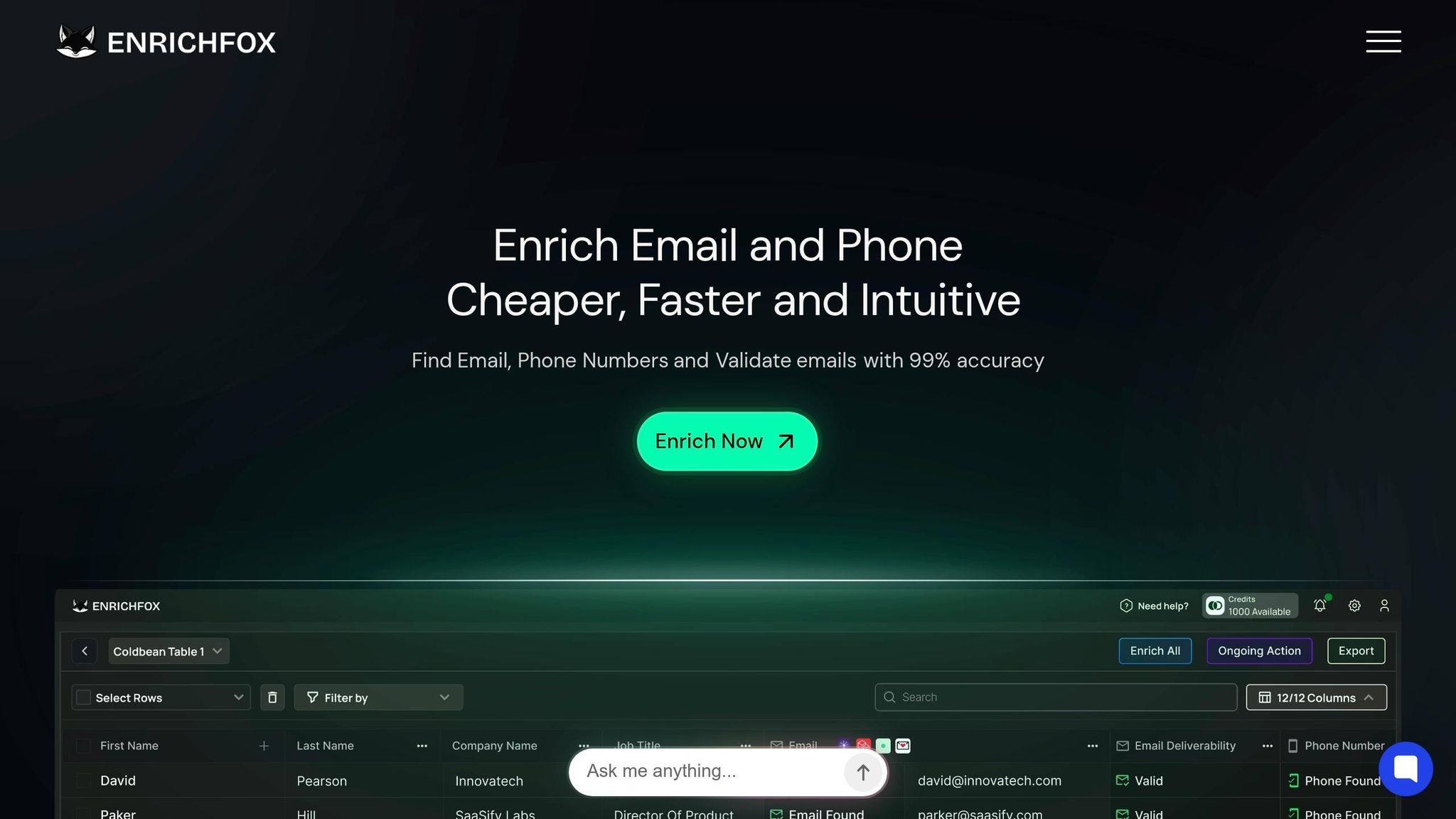
Enrichfox.ai keeps things simple with a pay-per-result pricing model - no monthly fees or upfront contracts. Here's the breakdown: $0.05 per valid email, $0.03 per phone number, and $0.00025 per email verification. This flexible approach ensures you only pay for successful results, making it a smart choice for teams with fluctuating lead volumes or tight budgets.
Accuracy of lead enrichment (email/phone)
Accuracy is where Enrichfox.ai shines, boasting a 99% email accuracy rate. This level of precision is essential for maintaining a strong sender reputation during outreach efforts. Plus, the platform includes built-in email verification services to safeguard deliverability before your campaigns go live.
Features and integrations
The platform is designed with practicality in mind. It supports bulk enrichment workflows through CSV uploads, offers API and webhook integrations for automation, and allows CSV exports. There's also live chat support to assist users. Enrichfox.ai primarily caters to small to mid-sized teams and startups that need reliable results without the complexity of enterprise-level tools.
Value for money
When compared to enterprise solutions like ZoomInfo or Apollo (which charges $49/month for 1,000 exports), Enrichfox.ai's pay-per-result model stands out for its cost efficiency. It's especially useful for handling large datasets - such as LinkedIn scrapes - where verified emails and phone numbers are essential, but monthly subscriptions aren't practical. Up next, we'll look at how another leading platform's pricing stacks up.
2. Clay
Pricing Structure and Tiers
Clay operates on a credit-based pricing model with unlimited team access, offering plans that range from a Free plan with 100 monthly credits to Enterprise contracts costing between $30,400 and $154,000 annually. For smaller teams, the Starter plan is priced at $149/month (or $134/month when billed annually) and provides 2,000 credits. The Explorer plan costs $349/month ($314/month annually) for 10,000 credits, while the Pro plan is $800/month ($720/month annually) for 50,000 credits.
Each workflow consumes between 10 and 50 credits per record. For instance, basic contact enrichment - covering details like name, email, and title - uses around 14 credits per record. On the other hand, more detailed enrichment, such as adding phone numbers and technographics, can require up to 75 credits. This credit consumption plays a significant role in determining the platform's cost-effectiveness, especially for teams focused on lead enrichment.
Accuracy of Lead Enrichment (Email/Phone)
Clay employs a "waterfall enrichment" strategy, leveraging over 100 providers in sequence to ensure higher match rates. This approach continues to query providers until a verified result is found, which significantly boosts accuracy. For email enrichment, Clay achieves a 78% success rate for verified emails, compared to just 42% when using Apollo as a standalone tool. For phone numbers, U.S. mobile numbers typically see an accuracy rate of 65–70%, while EU contacts hover around 30–40%.
However, one downside is that credits are charged even for failed lookups, which can lead to a waste of 20–30% of credits. Additionally, email verification often requires a two-step process - finding the email first and then verifying it - unless users take advantage of the BYOK (Bring Your Own Key) feature to integrate their own API keys.
Features and Integrations
One of Clay's standout features is Claygent, an AI-powered assistant designed to handle unstructured tasks that go beyond traditional API capabilities. For example, it can research SOC-II compliance or gather case studies, saving time on manual data collection. Another helpful tool is its conditional logic feature, which prevents unnecessary lookups and optimizes credit usage.
Clay also supports native CRM integrations with platforms like Salesforce, HubSpot, Pipedrive, and Dynamics, though these are only available on the Pro plan and higher tiers. Edward White, Head of Growth at beehiiv, shared his experience with Clay:
"With Clay, we shaved off about eight to ten hours per week on manual data work. It now feels more like refining strategy than chasing spreadsheets."
For high-volume users, the BYOK option is a game changer. It allows teams to connect their own API keys for providers like Prospeo or OpenAI, reducing processing costs compared to Clay's native credit system.
Value for Money
Clay is particularly effective for teams managing complex, high-volume workflows. By late 2025, the platform had reached $100M ARR, with an impressive year-over-year growth rate of 263%. However, managing credits effectively is crucial, as the system can become costly for teams with limited budgets. Clay is most suitable for teams spending over $300/month on enrichment; smaller teams might find it challenging to optimize credit usage efficiently.
When compared to flat pay-per-result models, Clay's cost per lead varies depending on the depth of enrichment required. The Pro plan stands out for its unlimited user access and native CRM integrations, making it an attractive choice for established sales teams. However, startups or smaller teams with simpler enrichment needs might benefit more from tools offering straightforward, pay-per-result pricing.
3. Apollo
Pricing Structure and Tiers
Apollo uses a credit-based system, with credits allocated annually for paid plans. The Free plan includes 900 credits per year, distributed monthly. Paid plans start at $49 per user/month (billed annually) for the Basic plan, which provides 30,000 credits. The Professional plan costs $79 per user/month and offers 48,000 credits, while the Organization plan is priced at $119 per user/month, includes 72,000 credits, and requires a minimum of three users.
Credit usage varies: a verified email costs 1 credit, a verified phone number requires 8 credits, and other enrichment tasks range from 1 to 8 credits depending on complexity. Credits that remain unused by the end of the term do not roll over, and canceling a plan forfeits any remaining credits immediately. For additional functionality, features like the International Dialer are available for an extra $119 per team/month.
Accuracy of Lead Enrichment (Email/Phone)
Apollo's database boasts over 210 million contacts. Testing of 5,000 B2B leads showed an overall accuracy rate of 50.1%, with US SaaS leads performing best at 62.7%, while EU B2B leads lagged behind at 29.4%. When Apollo identifies email addresses, its verification accuracy is high at 91.2%. However, the challenge lies in its ability to locate data in the first place.
Phone number validation tends to be less reliable compared to email data. Apollo's Waterfall Enrichment feature attempts to improve match rates by querying multiple data sources sequentially, but approximately 20% of credits may still be wasted on outdated or invalid data. To mitigate this, it's recommended to use third-party verification tools before launching large-scale outreach campaigns.
Features and Integrations
Apollo offers a range of features designed to simplify sales workflows. As an all-in-one platform, it includes native sequencing, a built-in dialer, and meeting scheduling tools. The Data Health Center helps manage contact data by tracking job changes and identifying gaps in target personas, addressing the industry's estimated 30% annual data decay rate. Additionally, Apollo's AI Assistant aids with lead scoring and research tasks, using just 1 credit per task.
For seamless operations, Apollo integrates natively with platforms like Salesforce, HubSpot, Pipedrive, Outreach, SalesLoft, Marketo, and SendGrid. Mark Turner, VP of Revenue Operations at Built In, shared:
"Apollo enriches everything we have: contacts, leads, accounts...And we don't really have to touch it, it just works".
The platform processes enrichment for around 100,000 leads daily across its user base.
Value for Money
For US-based tech companies, Apollo is a cost-effective solution compared to competitors like ZoomInfo. A 10-seat Professional plan costs approximately $12,000 annually, significantly less than ZoomInfo's median contract price of $31,875. This makes Apollo an attractive option for small and medium-sized businesses looking for an integrated prospecting and engagement tool. However, the Prospeo team cautions:
"Apollo is the obvious starting point for most SMB teams - and the most dangerous tool to rely on alone".
This highlights the need to pair Apollo with additional verification tools to protect sender reputation. The platform has a 4.7/5 rating on G2 from over 9,000 reviews, but its 2.3/5 score on Trustpilot reflects user concerns about credit expiration policies and billing transparency [6,30].
4. ZoomInfo
Pricing Structure and Tiers
ZoomInfo’s pricing model is geared toward enterprise users, with a focus on annual contracts and a seat-based system (minimum of three users). Pricing also incorporates a credit system for data exports and profile views.
The Professional plan starts at about $14,995 per year and includes 5,000 credits. The Advanced plan costs roughly $24,995 annually with 10,000 credits. For teams needing more advanced features, the Elite plan starts at $39,995 or higher, adding AI-driven tools and real-time buying signals.
Additional seats range from $2,000 to $5,000 each, and optional add-ons like Global Data (starting at $10,000) or CRM Enrichment (starting at $15,000) can significantly increase costs. Keep in mind, unused credits don’t roll over, and overages are charged between $0.25 and $0.50 per credit. Contracts often include auto-renewal clauses, requiring 60–90 days’ notice for cancellation, and annual price increases between 10–20% are common.
As Prospeo notes:
"The $14,995 base plan doesn't include phone numbers or intent data. Read that again... you're paying enterprise prices for a glorified contact database".
Accuracy of Lead Enrichment (Email/Phone)
ZoomInfo boasts a database of over 500 million professional contacts and 135 million verified phone numbers. While the company claims 95% accuracy, independent testing places email accuracy at 75–87%. Data reliability tends to be stronger in North America, while records from regions like EMEA and APAC may include outdated information or lack direct phone numbers. For example, in Europe, phone connect rates hover around 14%, compared to competitors like Cognism, which achieves 22%.
Unlike UpLead, which offers credit-back guarantees for bounced emails, ZoomInfo does not provide formal guarantees for data accuracy. Users have reported email bounce rates ranging from 15% to as high as 50%.
While data accuracy can be inconsistent, ZoomInfo compensates with advanced features and integrations that enhance outreach capabilities.
Features and Integrations
ZoomInfo extends beyond data collection with tools designed to streamline outreach and decision-making. Features like ZoomInfo Copilot and the GTM Context Graph leverage AI to analyze deal signals and optimize workflows. According to Andrew Giordano, VP of Global Commercial Operations at Analytic Partners, his team cut account research time by 85%, reducing it from three hours to just 15 minutes per account.
The platform integrates seamlessly with top CRMs like Salesforce, HubSpot, Microsoft Dynamics, and Marketo, as well as data warehouses like Snowflake. Other tools include WebSights, which identifies anonymous website visitors in real time, and the ReachOut Chrome Extension, enabling data enrichment directly on LinkedIn profiles.
Aaron Kotick, Managing Director at Deal IQ, highlights the transformative impact of these features:
"This is how a start-up hyper-accelerates. We went from being a firm no one knew about to working with the largest companies in the world – all because we found them in ZoomInfo".
These integrations and tools make ZoomInfo a valuable resource for enterprise teams looking to scale efficiently.
Value for Money
For companies with larger budgets, ZoomInfo offers extensive intelligence and cutting-edge AI capabilities. For example, Clum Creative reported a 10x ROI and a 104% increase in appointments set after adopting the platform. However, the steep starting price of over $15,000 per year limits its accessibility for smaller businesses.
On G2, ZoomInfo holds a 4.5/5 rating, with users praising its comprehensive database and powerful integrations. However, common complaints include opaque pricing, strict auto-renewal terms, and a challenging learning curve.
For teams with tighter budgets, alternatives like Enrichfox.ai offer 99% email accuracy, simpler pricing, and no long-term contracts, making them a practical choice for businesses not yet ready for enterprise-level tools.
5. Lusha
Pricing Structure and Tiers
Lusha uses a credit-based system for its services: retrieving a verified email costs 1 credit, while accessing a phone number requires 5 credits [48,50]. This setup means teams relying heavily on phone outreach will see their credits deplete faster.
The platform is available in five tiers:
- Free: Offers 40 credits per month at no cost.
- Starter: $37.45 per user per month (billed annually), with 4,800 credits per year.
- Pro: $52.45 per user per month (billed annually), with 7,200 credits per year.
- Premium: $299.95 per month for up to 5 seats, providing 40,800 credits annually.
- Scale: Custom pricing tailored to specific needs.
Annual plans come with a 25% discount compared to monthly billing [48,50]. However, there’s a catch: annual plans front-load all credits, which expire at the end of the billing cycle without rollover. In contrast, monthly plans allow unused credits to roll over up to twice the monthly limit [48,49,50]. It’s also worth noting that core CRM integrations, like Salesforce and HubSpot, are only available with the Scale tier [48,49].
Next, let’s take a closer look at the accuracy of Lusha’s lead enrichment capabilities.
Accuracy of Lead Enrichment (Email/Phone)
Lusha’s database boasts over 100 million business profiles and 60 million decision-maker emails. It uses a seven-step verification process and flags contacts with "Verified" badges to indicate reliability. However, accuracy can vary by region, with North America showing the best results [47,51]. According to Lusha, their overall accuracy stands at 81%, though independent reports suggest up to 98% accuracy for emails and 85% for phone numbers [6,47,51].
Frank Breen, Head of Sales at Revium.io, shared his experience:
"We achieved 95% deliverability with Lusha, and that's close to 100% accuracy".
Unlike some competitors that offer credit refunds for outdated data, Lusha deducts credits even for inaccurate information [47,48]. Given that B2B data decays at a rate of about 30% annually, focusing on "Verified" contacts is essential to minimize wasted credits.
With accuracy covered, let’s shift to Lusha’s features and integrations.
Features and Integrations
Lusha goes beyond contact data by providing real-time updates on job changes, promotions, funding events, and hiring trends, helping users time their outreach effectively [53,56]. Key features include bulk CSV enrichment, a Chrome extension for LinkedIn prospecting, and API access for custom CRM workflows [55,58].
Adam Wainwright, Head of Revenue at Cacheflow, highlighted the platform's impact:
"The moment we turned on Salesmotion, it became essential. No more hours on LinkedIn or Google to figure out who we're talking to".
Lusha integrates with major CRMs like Salesforce, HubSpot, Zoho, and Pipedrive, as well as sales engagement tools like Outreach and Salesloft. It also automatically fills in missing CRM fields such as seniority and company size, enabling instant lead scoring and routing [54,56]. For teams revisiting older leads or "closed-lost" opportunities, enriching data from the past 6–24 months can uncover new decision-makers or recently promoted champions.
Finally, let’s assess Lusha’s overall value for money.
Value for Money
Lusha sits between budget tools and high-end enterprise platforms. For comparison, enterprise solutions like ZoomInfo often start at $15,000 annually, offering broader datasets and advanced features. Meanwhile, Lusha’s Pro plan is priced at $52.45 per user per month and includes API access. However, the 5-credit cost for phone numbers can lead to quick credit depletion for phone-heavy teams [48,49].
On G2, Lusha has earned a 4.3 out of 5 rating from over 1,500 reviews [48,51]. On Trustpilot, however, it scores a much lower 1.3 out of 5, with common complaints about billing issues and limited support. Users often mention frustrations like the lack of credit refunds for inaccurate data and the fact that key features are locked behind the Scale tier [48,49].
For teams focused on email enrichment, Lusha’s pricing can be cost-effective. But for operations that rely heavily on phone outreach, alternatives like Enrichfox.ai - offering 99% accuracy and phone number validation without high credit costs - may be a better fit.
6. FullEnrich
Pricing Structure and Tiers
FullEnrich operates on a credit-based system, charging only for successfully verified data. Here's the breakdown:
- Work emails: 1 credit
- Personal emails: 3 credits
- Mobile phone numbers: 10 credits
Subscription plans include:
- Starter: $29/month for 500 credits
- Pro: $55/month for 1,000 credits
- Scale: $400–$500/month with custom credit options
These plans allow unlimited team members to share a single credit pool. Credits roll over for up to 3 months on monthly subscriptions and 12 months on annual plans. For teams needing extra flexibility, one-time credit packs range from 5,000 credits ($299) to 100,000 credits ($4,299), though these expire after 6 months. Opting for annual billing saves 30%, lowering the Starter plan to about $26/month.
Keep in mind, the Pro plan ($55/month) covers roughly 100 phone lookups due to the 10-credit-per-phone charge, which may not suit teams heavily reliant on phone outreach.
Accuracy of Lead Enrichment (Email/Phone)
FullEnrich uses a waterfall enrichment process, querying 15–20+ premium data providers - like Apollo, Hunter, and Datagma - until verified contact information is found. This method achieves match rates of 65% to 85%, far surpassing the 25–40% rates typical of single-source tools.
Performance varies by region:
- US/Canada: 89% email find rates, 86% for phone numbers
- EMEA: 84% for emails, 71% for phone numbers
- LATAM: 78% for emails, 67% for phone numbers
Triple email verification ensures bounce rates stay under 2%, even for catch-all addresses.
In 2025, Guideflow implemented FullEnrich to improve phone number coverage, increasing it from under 50% to over 85%. This change resulted in a 37% boost in their sales pipeline. Thomas Rebaud, CEO of Meero, praised the platform, stating:
"FullEnrich beats all of them [ZoomInfo, Apollo, Lusha] when you want to find the emails and phone numbers of prospects. The best part is that we actually saved money by switching to them."
For US and Canadian leads, FullEnrich goes a step further by verifying phone line ownership against the lead's name. Any landline numbers found during this process are added at no extra cost.
Features and Integrations
FullEnrich combines its competitive pricing with a range of integration options. Its reverse email lookup feature converts a work or personal email into a full person and company profile for just 1 credit. Bulk CSV uploads make list enrichment seamless, while API access supports custom workflows.
Integration options include:
- Clay, Zapier, Make, and n8n
- Native connections to HubSpot, Salesforce, and Pipedrive
- A LinkedIn Sales Navigator extension for one-click enrichment
Kevin Gohin, CEO at Hook Agency, shared his experience:
"With FullEnrich, we find 3 times more phone numbers for the same list of leads."
The platform is also SOC 2 Type II compliant and adheres to GDPR and CCPA standards. Unlike tools that rely on static databases, FullEnrich queries providers in real time, ensuring better data privacy and compliance.
Value for Money
FullEnrich positions itself between lower-cost tools and enterprise platforms, offering strong email accuracy and flexible credit rollovers. At $29 for 500 credits, the Starter plan is a solid choice for teams focused on email enrichment. However, the 10-credit-per-phone lookup cost can strain budgets for teams that rely heavily on phone numbers.
The platform holds a 4.8/5 rating on G2 (from over 160 reviews) and a 4.4/5 on Tekpon. Users highlight its high mobile number match rates and pay-for-success model, although the 6-month expiration on one-time credit packs is a common drawback.
For email-focused workflows, FullEnrich’s waterfall system delivers consistent results. However, if phone number validation plays a larger role in your process, tools like Enrichfox.ai - which offers 99% phone accuracy and more predictable pricing - might be a better fit.
7. Hunter.io
Pricing Structure and Tiers
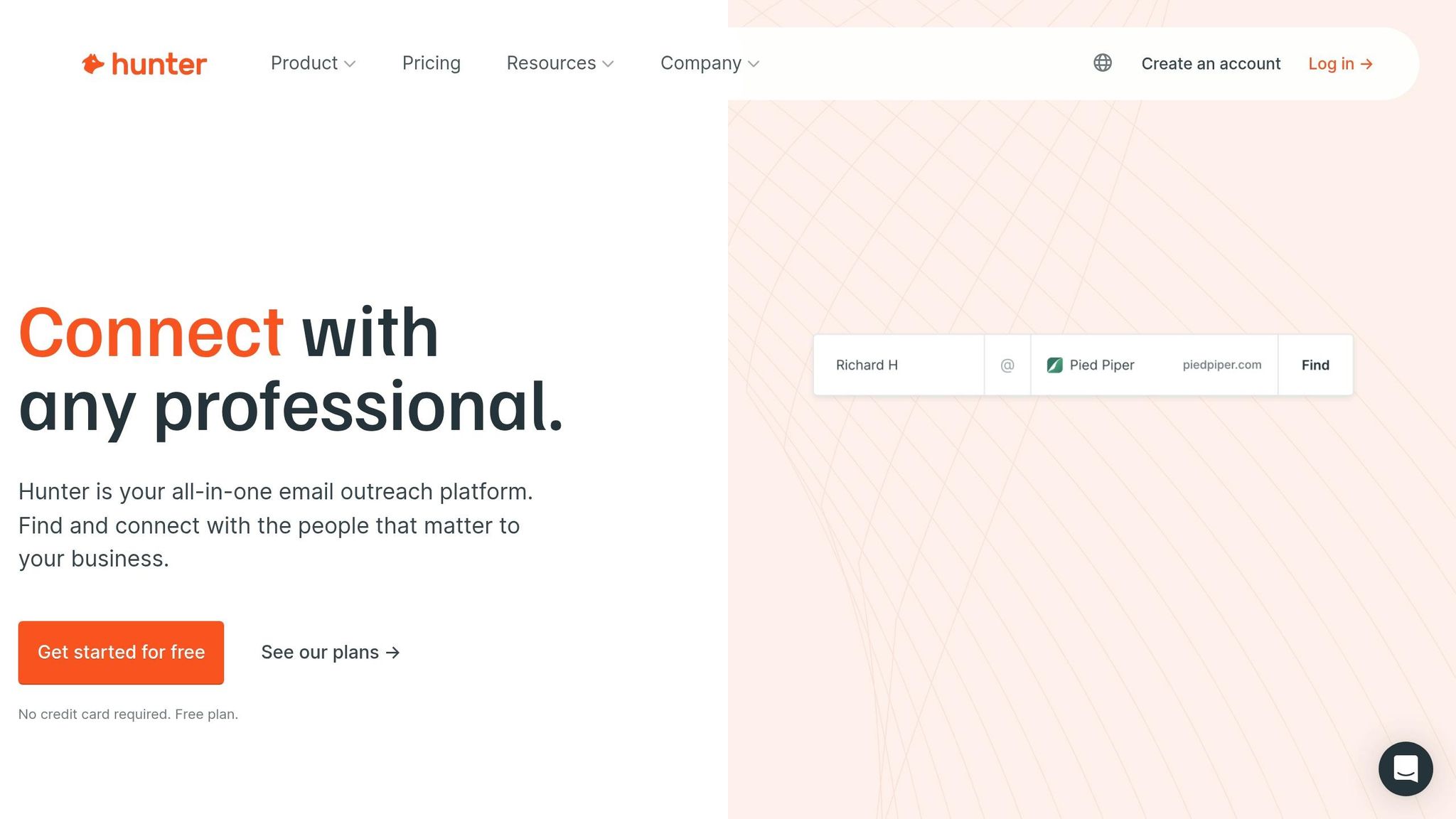
Hunter.io uses a Unified Credits system where all actions - such as search, verification, and enrichment - pull from the same credit pool. For example, finding an email uses 1 credit, while verifying an email costs 0.5 credits. The Bulk Domain Search is a standout feature, allowing users to find up to 10 emails with just 1 credit.
The pricing begins with a Free plan that provides 50 credits per month. Paid plans are as follows:
- Starter Plan: $49/month or $34/month when billed annually, includes 2,000 credits.
- Growth Plan: $149/month or $104/month annually, with 10,000 credits.
- Scale Plan: $299/month or $209/month annually, offering 25,000 credits.
All paid plans come with unlimited team members and automatic monthly re-verification of saved leads at no additional cost. If you exceed your credit limit, you can purchase credit packs for $10, which remain valid for three months.
The effective cost per deliverable email is around $0.059 when billed annually. This figure accounts for the fact that not all lookups result in valid emails, making it higher than the $0.017 implied by simple math. For teams handling large volumes, the Growth plan offers better cost efficiency compared to the Starter plan.
Accuracy of Lead Enrichment (Email/Phone)
Hunter.io has demonstrated strong performance in lead enrichment. In a 2026 benchmark of 15 email verification tools using 3,000 real business emails, Hunter.io ranked first with a 70% accuracy rate. Another independent test showed an accuracy rate of 87% and a coverage rate of 71%.
The platform’s verification process is thorough, checking syntax, MX records, SMTP responses, and even handling catch-all domains with its proprietary solution. Michael Gorodisher, Head of Sales at Planhat CRM, shared his experience:
"What I enjoy most about Hunter is the affordability and the data accuracy. I love both the Finder and the Email Verifier!"
However, only about 32.5% of email lookups yield valid results, which means the platform’s overall enrichment effectiveness is limited. Additionally, Hunter.io’s phone number data is less reliable and doesn’t match the quality offered by competitors like Lusha or ZoomInfo. Among user groups, US mid-market companies (100–999 employees) see the highest accuracy at 91%, while European leads achieve 84%.
Features and Integrations
Hunter.io combines email finding with a suite of tools designed to streamline outreach. These include a B2B database called Discover, email sequences, and an AI Writing Assistant. Its Lead Enrichment API enables access to over 100 attributes - like demographic, firmographic, and technographic data - using just an email address or LinkedIn profile.
The platform integrates seamlessly with popular CRM tools like HubSpot, Salesforce, Pipedrive, and Zoho. A browser extension allows users to enrich data directly from LinkedIn profiles or company websites. Additionally, a Google Sheets add-on simplifies list verification, saving teams time on manual processes. Sean Gallagher, Commercial Account Executive at Lattice, remarked:
"Hunter is great for saving time, building pipelines and prospecting. Before Hunter, I spent a long time guessing emails... The email verifier is a game changer."
These features enhance Hunter.io’s value for email-driven teams by pairing accuracy with convenience.
Value for Money
Hunter.io boasts a 4.4/5 rating on G2, based on over 630 reviews. Users highlight its user-friendly interface and reliable email accuracy, though some express concerns about credit consumption and the platform's limited phone data. With over 6 million users, Hunter.io is a strong choice for teams prioritizing email enrichment.
For $34/month (annual billing), the Starter plan delivers 2,000 credits, enabling small teams to verify approximately 1,333 email pairs monthly. However, for teams requiring accurate phone data alongside email capabilities, alternatives like Enrichfox.ai - which offers 99% phone accuracy and more predictable pricing - might be a better fit.
8. UpLead
Pricing Structure and Tiers
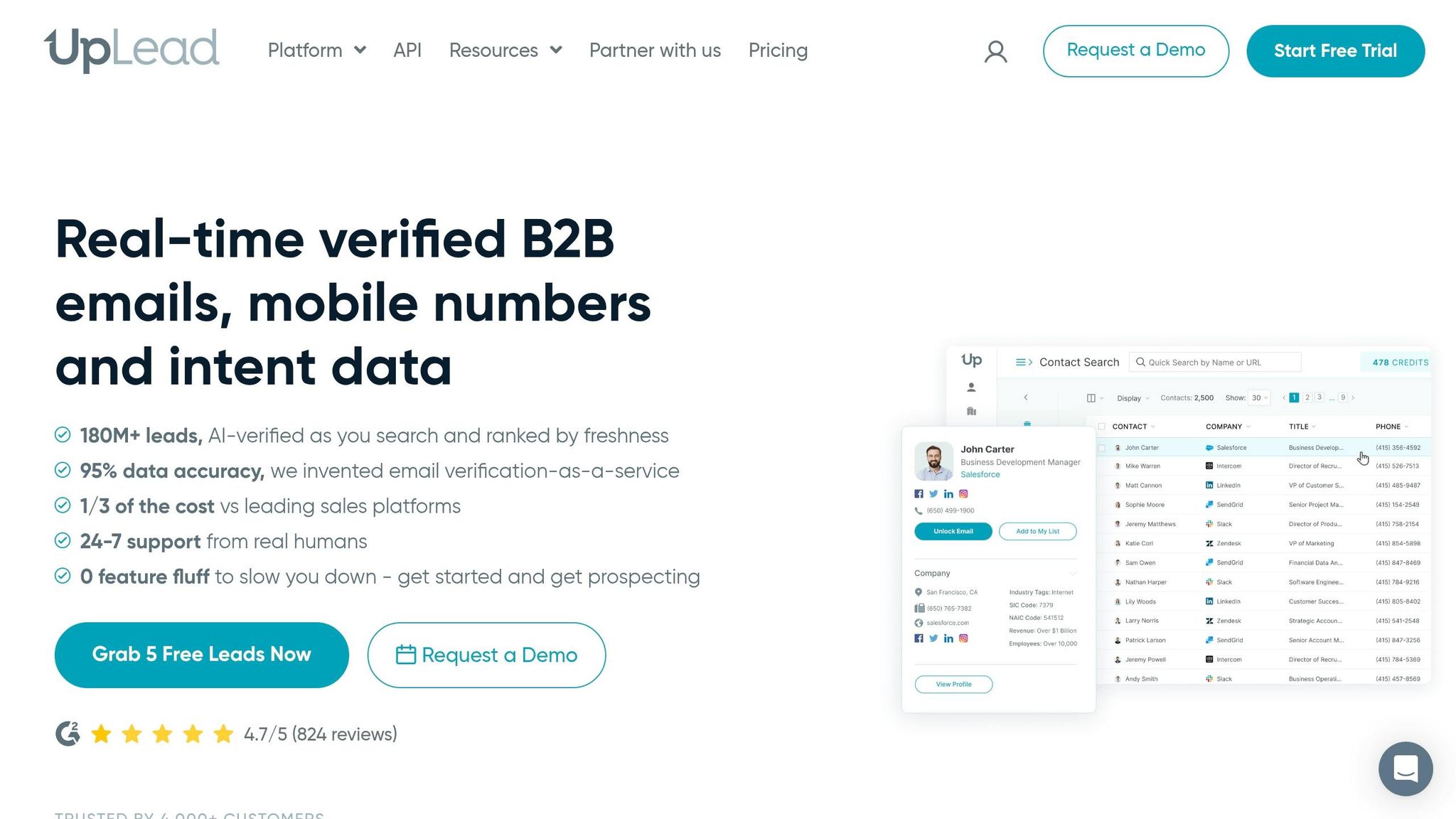
UpLead operates on a straightforward credit-based system, making it easy to manage your budget. Each credit equals one verified contact, which includes both an email address and a mobile direct dial number.
The platform offers flexible billing options, including monthly subscriptions or annual plans with a 25% discount. There’s also a 7-day free trial that comes with 5 credits. Here’s a quick breakdown of the pricing:
- Essentials Plan: $99/month or $74/month with an annual subscription, offering 170 credits.
- Plus Plan: $199/month or $149/month annually, providing 400 credits.
- Professional Plan: $399/month or $299/month annually, with 1,000 credits.
- Enterprise Plan: Custom pricing for 2,000+ credits.
Annual subscribers benefit from credit rollovers, while monthly plan credits expire at the end of each billing cycle. Note that the Essentials and Plus plans are limited to single users, while multi-user access is available only with the Professional and Enterprise tiers.
Accuracy of Lead Enrichment (Email/Phone)
UpLead guarantees a 95% accuracy rate for verified emails, supported by real-time verification when you unlock a contact. The platform boasts a database of over 160 million B2B contacts. If an email bounces, UpLead offers a credit-back guarantee, ensuring you only pay for valid leads.
Success stories abound. Craig Valentine from Whitewater Consulting reported generating over $100,000 in revenue with a 12,526% ROI using UpLead. He shared:
"We looked at ZoomInfo and ultimately chose UpLead after thorough research. We found that the pricing options with UpLead plus the accuracy of data were perfect for our needs."
Similarly, Kyle Mende of Code Red Safety closed $150,000 in sales within just 60 days, and Raymond Yau of Fastsigns achieved an 80% reply rate on emails sourced through UpLead.
Features and Integrations
UpLead offers a robust set of features, including 50+ search filters like technographics, which track over 16,000 technologies, and buyer intent data to pinpoint active prospects. The Chrome extension makes it easy to gather and enrich lead data directly from LinkedIn or company websites. Additionally, you can upload existing lists to fill in missing contact and company information.
The platform integrates seamlessly with major CRMs such as Salesforce, HubSpot, Zoho, Pipedrive, and Microsoft Dynamics 365. It also works with sales engagement tools like Outreach, SalesLoft, and Reply.io. Through Zapier, UpLead connects to over 1,500 other apps, and higher-tier plans provide access to both the Enrichment API and Prospector Pro API for developers.
Value for Money
UpLead has a 4.7/5 rating on G2 from over 800 reviews and is recognized as the "#1 Highest Rated Lead Intelligence Software" by G2. Users consistently highlight its high email accuracy, transparent pricing, and ease of use.
For $74/month on an annual plan, the Essentials tier provides 170 verified contacts, which breaks down to about $0.44 per contact. Compared to competitors charging upwards of $15,000 annually or delivering only 60–70% email accuracy, UpLead’s 95% accuracy and clear pricing make it a standout option. However, keep in mind that lower-tier plans are limited to single-user access.
9. Adapt.io
Pricing Structure and Tiers
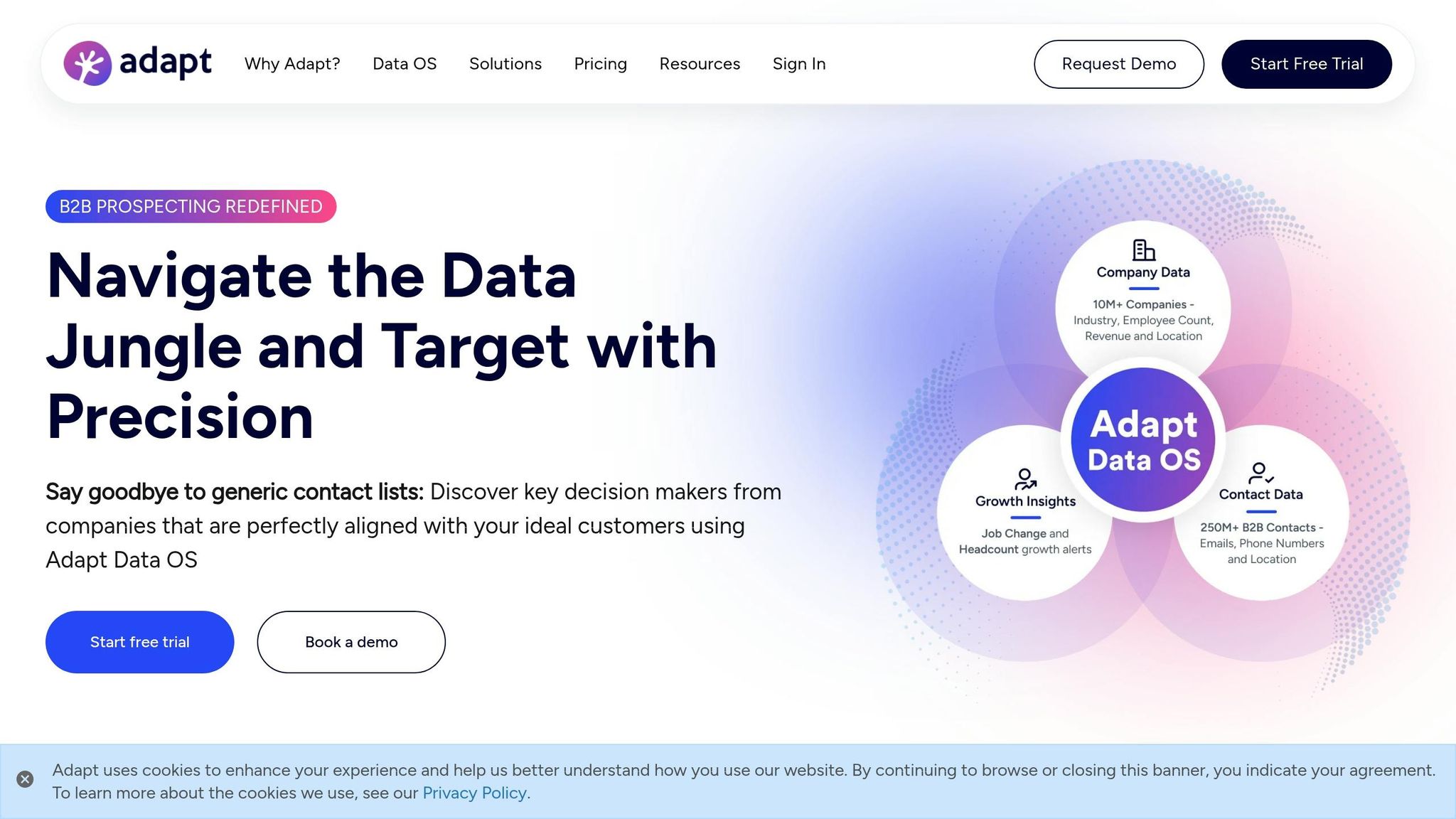
Adapt.io uses a credit-based system divided into three types: Email, Enrichment, and Phone. This setup gives users flexibility in allocating their budget, though it might feel a bit complex initially.
Here’s a breakdown of the pricing tiers:
- Free: Includes 25 email and enrichment credits, with a daily limit of 25 contacts.
- Starter: Costs $49/month (or $490 annually) and provides 500 email and enrichment credits, with a 50-contact daily cap.
- Basic: Priced at $99/month (or $990 annually), offering 1,000 email and enrichment credits, 100 phone credits, and a 100-contact daily limit.
- Custom: Designed for larger teams, this tier removes daily limits and includes extras like API access. Pricing is available upon contacting sales.
One thing to note is that even the paid plans come with daily contact limits - 50 for Starter and 100 for Basic - which might slow down high-volume outreach efforts. Annual billing offers an approximate 20% discount, but keep in mind that unused monthly credits don’t roll over.
Next, let’s dive into how Adapt.io performs in terms of data accuracy and its impact on lead generation.
Accuracy of Lead Enrichment (Email/Phone)
Adapt.io boasts a database of over 250 million business contacts and 10 million company profiles. Its email accuracy is estimated to be around 80%, which outperforms Apollo.io’s 60–70% but falls short of competitors like Prospeo (98%) and UpLead (95%).
Users have reported tangible results. For example, Lori Frucht, a Marketing Director, shared that she saw a "30% increase in email success" after using Adapt.io. Similarly, Dondi Alentajan, VP of Sales & Marketing, noted a "25% increase in cold prospecting revenue." The platform’s email verification, available through its Chrome extension and lead builder, makes it a solid choice for teams operating on a budget.
Features and Integrations
Adapt.io complements its pricing and accuracy with tools designed to simplify prospecting. The Prospector Chrome extension allows users to pull verified email addresses and phone numbers directly from LinkedIn profiles and company websites. It also offers over 25 advanced search filters, including options for job title, department, employee count, revenue, and location. For those targeting niche industries, the platform provides access to more than 3,000 specialized technology sector classifications.
Automation features like "Saved Search" alerts notify users when new contacts match their criteria, while "Job Change Alerts" track when prospects move to new companies. Adapt.io also integrates seamlessly with popular platforms like Salesforce, HubSpot, Pipedrive, Zoho CRM, Marketo, Outreach, Salesgear, and Zapier.
Value for Money
Adapt.io holds a strong 4.6/5 rating on G2, based on feedback from over 2,700 users. On the Starter plan, the cost per revealed email is $0.098. While this is double Hunter.io’s $0.049 per email, it remains far more affordable than many high-end tools.
However, the strict daily contact limits might be a drawback for teams handling large volumes. If your team needs to exceed 100 contacts per day, upgrading to the Custom tier would be the better option.
Top 10 BEST Lead Gen Tools (2026)
10. Prospeo
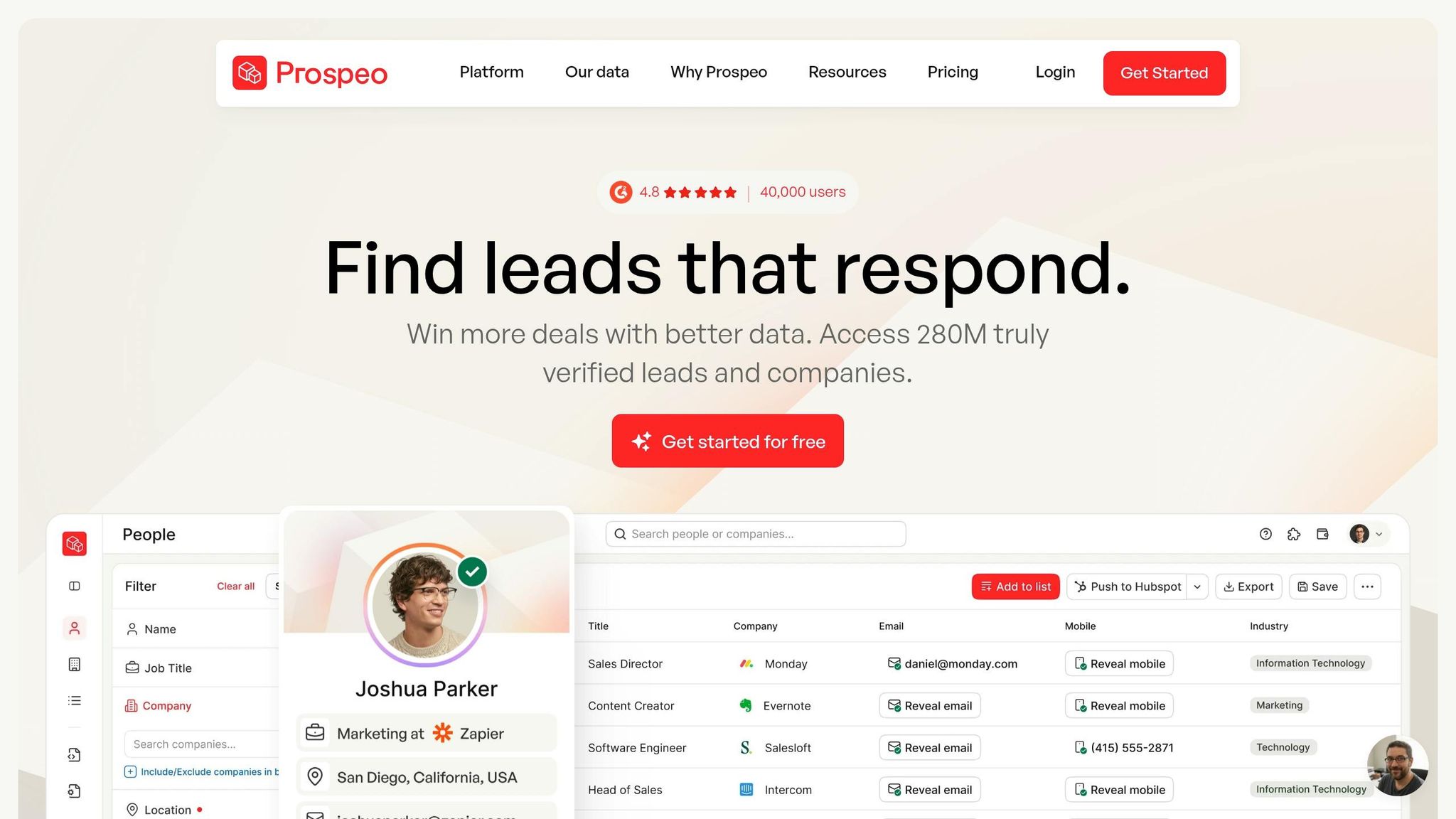
Prospeo stands out with its pay-for-success model and a strong focus on data precision, making it a go-to tool for lead enrichment.
Pricing Structure and Tiers
Prospeo operates on a credit-based system where you only pay when the platform successfully retrieves data. If no email or phone number is found, there’s no charge. The platform offers four main pricing tiers, with annual billing providing a 30% discount compared to monthly rates.
| Plan | Monthly Rate | Annual Rate | Credits Included | Key Features |
|---|---|---|---|---|
| Free | $0 | $0 | 100/mo | Chrome extension, filters, 25-row selection limit |
| Starter | $49 | $37/mo | 2,000/mo | API access, 20,000-row selection, integrations |
| Growth | $99 | $74/mo | 5,000/mo | HubSpot/Salesforce sync, team sharing, job change tracking |
| Pro | $249 | $187/mo | 15,000/mo | Priority support, higher API limits (30 requests/sec), 12 intent topics |
Credit consumption depends on the feature: 1 credit per email found, 10 credits per mobile number, and 0.5 credits for email verification. Domain searches cost 1 credit but return up to 50 emails. Credits expire at the end of each billing cycle, but add-ons are available starting at 1,000 credits for $10 if you run out mid-month.
Accuracy of Lead Enrichment (Email/Phone)
Prospeo boasts a 98% email accuracy rate, backed by a database of 143 million verified emails and 125 million verified mobile numbers. Its 5-step verification process ensures high deliverability by handling catch-all domains and removing spam traps.
Success stories include Snyk, whose 50-person sales team reduced their email bounce rate from 35–40% to under 5%, resulting in a 180% increase in AE-sourced pipeline and over 200 new opportunities per month. GreyScout achieved similar results, with a 140% pipeline increase and bounce rates dropping from 38% to under 4%.
"We've used a lot of email finders, but Prospeo is the only one where the emails are actually verified. The bounce rate dropped by over 70%." - Pete Lipton, Senior Director of Sales, Snyk
Features and Integrations
Prospeo’s Chrome extension, used by 40,000 users, integrates seamlessly with LinkedIn, company websites, and CRMs. It offers 30+ search filters, including technographics, job change signals, funding data, and buyer intent powered by 15,000 Bombora topics. Unlike competitors that refresh data every six weeks, Prospeo updates its database weekly, addressing the 2.1% monthly decay rate of B2B contact data.
All paid plans include integrations with tools like Clay, Zapier, Outreach, and Lemlist. Native integrations with HubSpot and Salesforce are available on the Growth and Pro tiers. The platform’s API, with a 92% match rate, provides over 50 data points per contact, further enhancing lead enrichment workflows.
Value for Money
Prospeo holds a 4.8/5 user rating, with competitive pricing. At the Starter level, the cost per email is approximately $0.025, while the Pro plan lowers it to about $0.01 per email. This cost-effective, credit-based system ensures you pay only for verified data.
Teams using Prospeo report booking 26% more meetings compared to ZoomInfo users and 35% more than Apollo users. While Enrichfox.ai offers a slightly higher accuracy rate, Prospeo’s pricing - especially at the Pro level - makes it a strong contender. However, the 10-credit cost for mobile numbers can make phone-heavy outreach campaigns more expensive.
Pricing and Features Comparison
When selecting a lead enrichment tool, it's all about finding the right balance between cost, accuracy, and the features your team needs. Prices can range from budget-friendly options like FullEnrich at $29 per month to enterprise-level solutions like ZoomInfo, which can cost around $15,000 annually.
Take Enrichfox.ai, for example. It uses a pay-as-you-go model: $0.00025 per verified email, $0.05 per found email, and $0.03 per phone number. With a 99% accuracy rate, it stands out as a competitive choice. For comparison, Prospeo achieves 98% accuracy, while Apollo trails at 79%.
| Tool | Starting Price | Mid-Tier Price | Ideal For | Email Accuracy | Unique Advantage |
|---|---|---|---|---|---|
| Enrichfox.ai | Pay-per-use ($0.00025 per email) | N/A | Cost-conscious teams | 99% | Highest accuracy, no monthly fees |
| FullEnrich | $29/mo | $79–$149/mo | Budget-friendly option | Varies | Pay only for valid results |
| Apollo | Free | $49–$99/user/mo | SMB all-in-one | 79% | 275M+ contacts, sequencing included |
| Prospeo | Free (75 emails) | Pay-per-use (~$0.01) | Email deliverability | 98% | Weekly data refresh versus 6-week average |
| Lusha | Free (5 credits) | $29.90–$69/user/mo | Quick phone lookups | N/A | Chrome extension simplicity |
| Clay | Free | $134–$720/mo | RevOps automation | N/A | 100+ sources, AI agents |
| Hunter.io | Free (25 searches) | $49–$149/mo | Email-only focus | N/A | Domain search specialization |
| UpLead | $99/mo | $199/mo | Mid-market value | 95% guarantee | Lower cost compared to ZoomInfo |
| ZoomInfo | ~$15,000/yr | ~$31,875/yr (median) | Enterprise outbound | 87% | 500M+ contacts, intent data |
| Adapt.io | $49/mo | $99/mo | Niche verticals | N/A | Industry-specific targeting |
For teams working with a budget under $500 per month, a combination of Enrichfox.ai's pay-per-use pricing and Apollo's free tier for database searches and sequencing offers a strong, cost-effective solution without the need for long-term commitments.
Another factor to consider is data freshness. With tools like Prospeo, which refreshes data weekly, and Enrichfox.ai, which provides real-time validation, you can avoid the pitfalls of outdated databases. These features can add more value over time compared to static data sources.
The cost-per-email can vary significantly. While Enrichfox.ai charges as little as $0.00025 for verified emails and Prospeo operates at around $0.01 per email, enterprise solutions like ZoomInfo often have much higher per-contact costs due to their annual pricing structure. For phone number enrichment, Enrichfox.ai also stands out with its competitive rate of $0.03 per phone number, making it a strong contender for teams aiming to stretch their budgets further.
Conclusion
Selecting the right lead enrichment tool boils down to balancing your budget, data accuracy, and team workflow needs. For startups or solo founders working within tight constraints, Apollo.io's free tier (offering 75–100 credits per month) and Enrichfox.ai's pay-per-use model ($0.00025 per verified email) provide affordable entry points without requiring monthly commitments. Apollo also combines enrichment and outreach capabilities, which can help minimize overall tech expenses. However, it's important to weigh these savings against the need for dependable, high-quality data.
When accuracy is a top priority, tools like Enrichfox.ai (99%), Prospeo (98%), and UpLead (95%) lead the pack, while others may prioritize broader feature sets over precision. For outreach in Europe, Cognism outshines competitors, achieving a 98% match rate compared to ZoomInfo's 72% in EMEA-specific tests.
Pricing flexibility is another critical factor. Teams with smaller budgets can benefit from tools offering flexible payment models, allowing them to build an efficient tech stack without committing to long-term contracts. For high-volume cold calling, platforms like Cognism or ZoomInfo stand out with their verified mobile number databases. Meanwhile, technical RevOps teams may prefer Clay, which enriches data through over 100 sources using a waterfall approach. Considering that poor data quality costs businesses around $15 million annually, prioritizing accuracy over sheer database size is essential for maximizing ROI.
For mid-sized companies looking for reliable data at reasonable prices, options like UpLead ($99/month) and FullEnrich ($29/month) offer solid value with their "pay only for valid results" pricing models. On the other hand, smaller teams with annual budgets under $10,000 might find enterprise-level platforms like ZoomInfo too expensive, often achieving better results with a leaner two-tool stack costing around $200/month. Ultimately, the key is finding the right balance between cost, accuracy, and features to meet your business needs effectively.
FAQs
How do I estimate my monthly cost per lead before choosing a tool?
To figure out your monthly cost per lead, start by looking at the tool's pricing and your expected lead volume. Simply divide the total monthly cost by the number of leads you plan to enrich. For instance, if the tool costs $100 per month and you enrich 1,000 leads, your cost per lead would be $0.10. Also, explore whether the tool offers flexible plans, bulk discounts, or per-lead pricing to better match your specific requirements.
When should I choose pay-per-result pricing instead of credits or annual contracts?
Pay-per-result pricing is a smart choice if your lead enrichment needs are occasional, highly specific, or if you prefer paying solely for verified data - like accurate emails or phone numbers. This approach helps you manage costs efficiently and avoids the hassle of unused credits or ongoing subscriptions. However, if your business requires consistent, high-volume data enrichment, credit-based or annual plans might provide better overall value. Opt for pay-per-result when you need flexibility for short-term, targeted tasks.
How can I validate accuracy claims and avoid email bounces?
To ensure your data is accurate and reduce email bounce rates, opt for lead enrichment tools equipped with strong data verification capabilities. For example, platforms like Enrichfox.ai boast an impressive 99% accuracy in email validation, along with real-time API integrations that help keep your data reliable. Look for tools that offer features like real-time validation, syntax checks, domain verification, and deliverability assessments. These functions help maintain a clean database by weeding out outdated or invalid contacts.